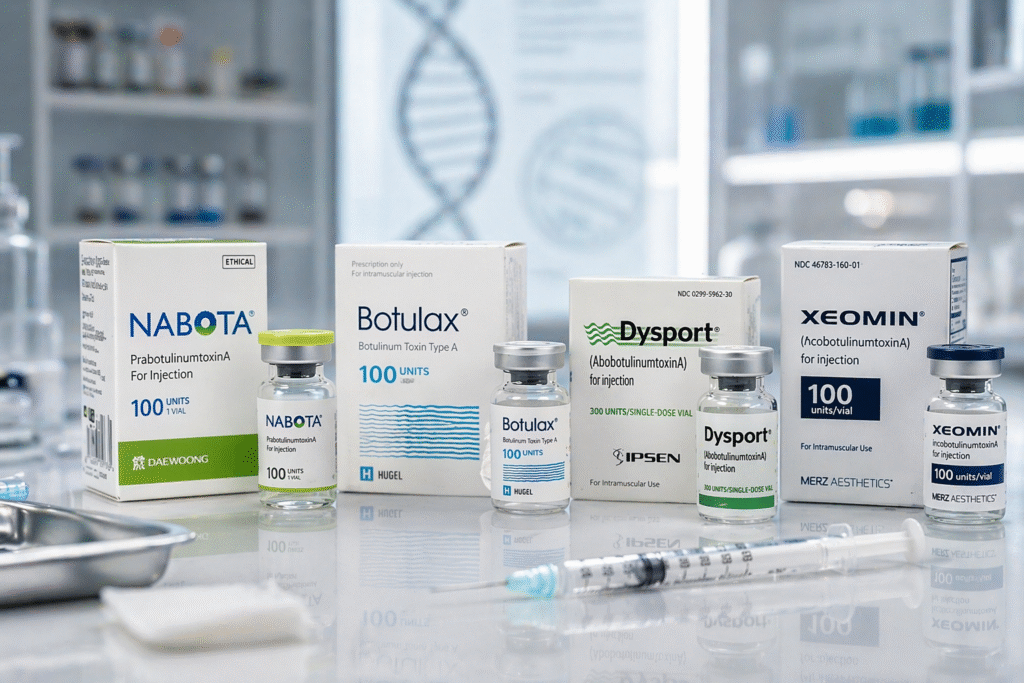
Botulinum toxin temporarily reduces nerve signals to selected facial muscles. When those muscles contract less, the skin above them folds less during facial expressions, so dynamic wrinkles such as frown lines look softer. Botulinum toxin does not add volume or remove every type of wrinkle, and its effect wears off over a few months.
This guide from Korea Derma explains how the process works, which lines respond, why results fade and where Korean botulinum toxin brands fit in the product category. It is written for adults researching treatment and for professionals who study aesthetic products.
How does botulinum toxin reduce wrinkles?
Botulinum toxin reduces wrinkles by weakening the contraction of the muscles that crease the skin. It belongs to a group of medicines called neuromodulators, which change how a nerve signals a muscle.
Nerve signals and muscle movement
Every facial expression starts with a nerve signal. Where a nerve meets a muscle, the nerve releases acetylcholine, a chemical messenger that tells the muscle fibers to contract (Mount Sinai). Botulinum toxin limits the release of acetylcholine in the treated muscle. Cleveland Clinic describes the result in plain terms: the toxin blocks nerve signals to the injected muscle, so the muscle can no longer tense up fully.
Less contraction and less skin folding
Many facial muscles attach to the skin above them. Each time such a muscle contracts, it pulls the skin together into a crease. With a weaker contraction, the crease is shallower and harder to see. The FDA describes botulinum toxin products as injectable drugs that keep muscles from tightening, so wrinkles do not show as much.
Why this affects expression lines
Expression lines – also known as dynamic wrinkles – develop and deepen as a result of repetitive movements, such as frowning, raising your eyebrows, squinting, or smiling. Because botulinum toxin specifically targets these movements, it is most effective for treating this type of wrinkle. Botulinum toxin does not fill in folds or restore lost volume, therefore, wrinkles caused by other factors are less responsive to this treatment. A crease that appears only when you frown is a classic example of a dynamic wrinkle. If, however, a wrinkle is visible even when your face is relaxed, it means there are other underlying causes – which we will discuss in the next section.
Which wrinkles can botulinum toxin soften?
Botulinum toxin can soften dynamic expression lines, the ones that appear when the face moves. Familiar examples are frown lines between the eyebrows, horizontal forehead lines and crow’s feet at the outer corners of the eyes. The FDA describes approvals for the temporary improvement in the appearance of one or several types of facial lines, and each product has its own approved list.
| Concern | Main contributing factor | What the mechanism can and cannot address |
|---|---|---|
| Dynamic expression lines | Repeated contraction of facial muscles | Can soften the crease while the muscle contracts less; the effect fades as movement returns |
| Lines visible at rest | Years of creasing plus changes in the skin itself, such as lower elasticity | May look partly softer if movement still deepens them; the crease set into the skin can remain |
| Volume loss and skin laxity | Thinning tissue and loose skin, independent of muscle activity | Not addressed by reducing muscle movement; dermal fillers are a separate category that adds volume |
Many lines combine the first two rows. A frown line can deepen with movement and still show faintly at rest. Reducing the frown softens the moving part, while the resting crease may stay. A review in American Family Physician notes that static wrinkles respond more slowly than dynamic ones, and deep static lines may not respond.
Why are the effects temporary?
The effects of botulinum toxin are temporary because the treated nerve endings gradually recover and the muscle regains its usual activity. As the muscle moves more, the skin folds again and expression lines return.
The American Academy of Dermatology (AAD) says improvements last about 3 to 4 months, and sometimes longer. That figure is a general guide from one organization. The timing for a particular person depends on the product, the treated area and individual response, and other medical sources give somewhat different ranges.
Results also take time to appear. The AAD notes that most people see results within 3 to 7 days. The effect then fades gradually, with no fixed day when movement comes back. When botulinum toxin wears off completely, the face moves as it did before treatment, and the lines look the way they did at the start. The AAD notes that another treatment can follow once lines return. Whether and when to repeat it is a decision for a medical professional, based on how the lines and muscles look at that point.
How is botulinum toxin different from dermal fillers?
Botulinum toxin and dermal fillers work in different ways. Botulinum toxin reduces the activity of specific muscles, while dermal fillers add volume or structure under the skin.
The FDA places them in separate regulatory categories. Botulinum toxin products are injectable drugs that keep muscles from tightening. Dermal fillers are gel-like substances injected under the skin to create a smoother or fuller appearance, and the FDA regulates them as medical devices. Cleveland Clinic lists hyaluronic acid, collagen and calcium hydroxylapatite among filler materials.
The difference shows which lines each category is designed for. A crease that forms with a frown comes from movement, so a product that reduces movement acts on it. A fold caused by lost volume comes from missing support under the skin, and a muscle-relaxing drug cannot replace that support. The FDA also notes that the safe use of dermal fillers combined with botulinum toxin has not been evaluated in clinical studies.
Where do Korean botulinum toxin brands fit?
Korean botulinum toxin brands belong to the same broad product category as Botox, but each brand is a separate medicine. Botox is a trade name; botulinum toxin is the category. Cleveland Clinic notes that Botox is one of several brands and that not all of them treat the same problems.
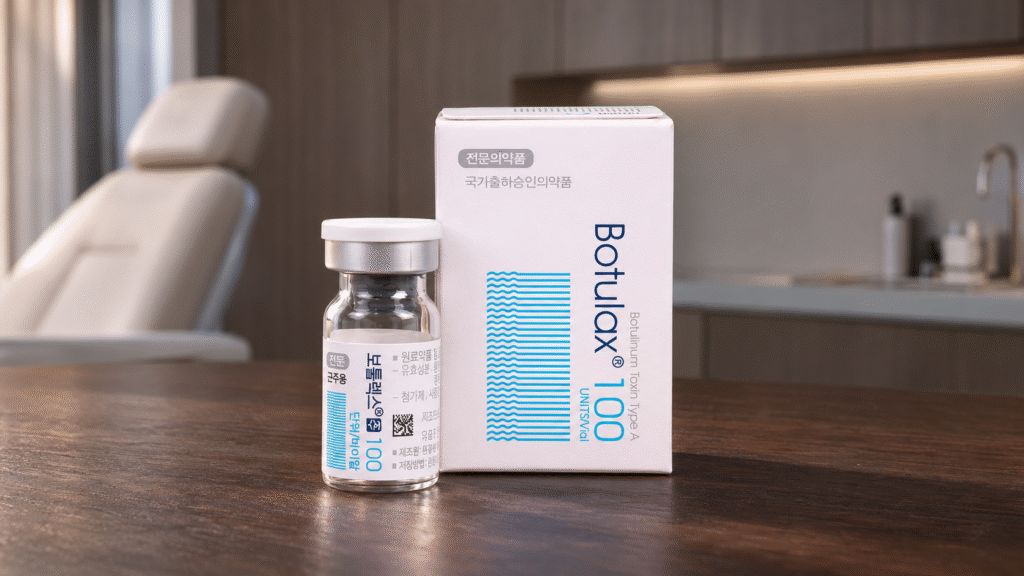
Korea Derma publishes information about Korean aesthetic brands, including Nabota, Botulax and Innotox. Their shared product category does not make them identical medicines. Products from different manufacturers can differ in formulation, physical form, potency units and approved uses. A general mechanism shared across the category does not show that two products can be swapped or that they carry the same indications.
Regulatory status belongs to a specific product in a specific market. An approval granted to one medicine does not carry over to another brand or to a different package of the same brand. For a closer comparison of two names, see how Nabota and Botox differ.
Frequently asked questions
Does botulinum toxin fill wrinkles?
No. Botulinum toxin does not add any substance beneath the skin. Instead, it weakens the contractions of specific muscles, which results in less skin folding during facial expressions. Dermal fillers work differently: they are gel-like products that add volume. The FDA (U.S. Food and Drug Administration) classifies them as medical devices – distinct from products based on botulinum toxin.
Does it work on every type of wrinkle?
No. Botulinum toxin acts on lines caused by muscle movement, such as frown lines, forehead lines and crow’s feet. Lines that stay visible at rest also reflect changes in the skin, so they may soften only partly. Folds caused by volume loss or loose skin do not depend on muscle activity, so this mechanism does not address them.