Korean dermal fillers: types, brands, benefits and how to choose
Korean dermal fillers are professional injectable products used for wrinkle correction, facial contouring, and volume restoration. Most are based on cross-linked hyaluronic acid, yet their density, elasticity, and intended treatment depth differ considerably, which is why no single product suits every task. KoreaDerma is a specialized store for Korean aesthetic medical products and lists more than 50 items in its Korean dermal fillers catalog. This guide covers the main filler types, the brands available, and the criteria practitioners use to choose between them.
What are Korean dermal fillers?
A dermal filler is a sterile injectable gel placed into the skin or deeper tissue by a qualified practitioner to add volume, support a facial contour, or reduce the appearance of a wrinkle. A Korean dermal filler is a product of this class developed and manufactured in South Korea, where injectable aesthetics is a large and well-established clinical field.
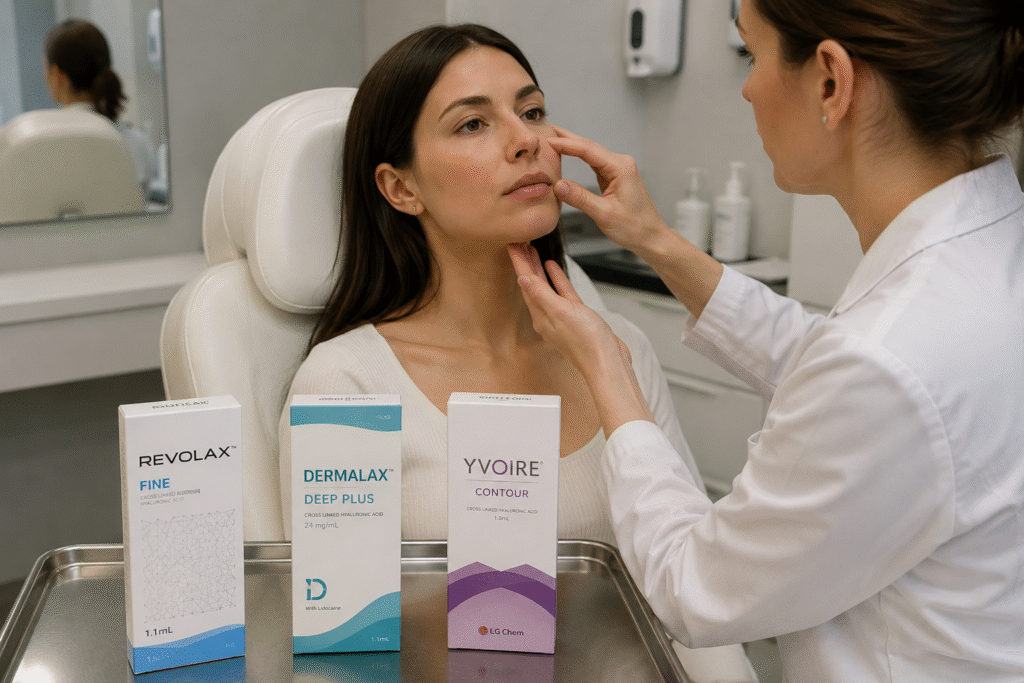
A hyaluronic acid filler is an injectable gel whose main active ingredient is stabilized hyaluronic acid, a polysaccharide naturally present in human skin. Unmodified HA degrades within hours, so these products use cross-linked hyaluronic acid : HA chains chemically bonded into a three-dimensional gel network, most often with BDDE. DERMALAX Deep Plus lists 24 mg/ml of non-animal hyaluronic acid stabilized this way.
Two gel properties drive product selection:
- Filler viscosity – resistance to flow, meaning how readily the gel spreads through tissue after placement.
- Filler elasticity – capacity to hold and recover shape under tissue pressure and facial movement.
No single filler is universal as a result. A soft gel formulated for superficial lines will not hold projection in the chin, and a dense structural gel placed in thin, mobile tissue can leave a visible ridge.
Why Korean dermal fillers are growing in popularity
South Korea has built a dense clinical and manufacturing ecosystem around injectable aesthetics, and its filler ranges reflect that:
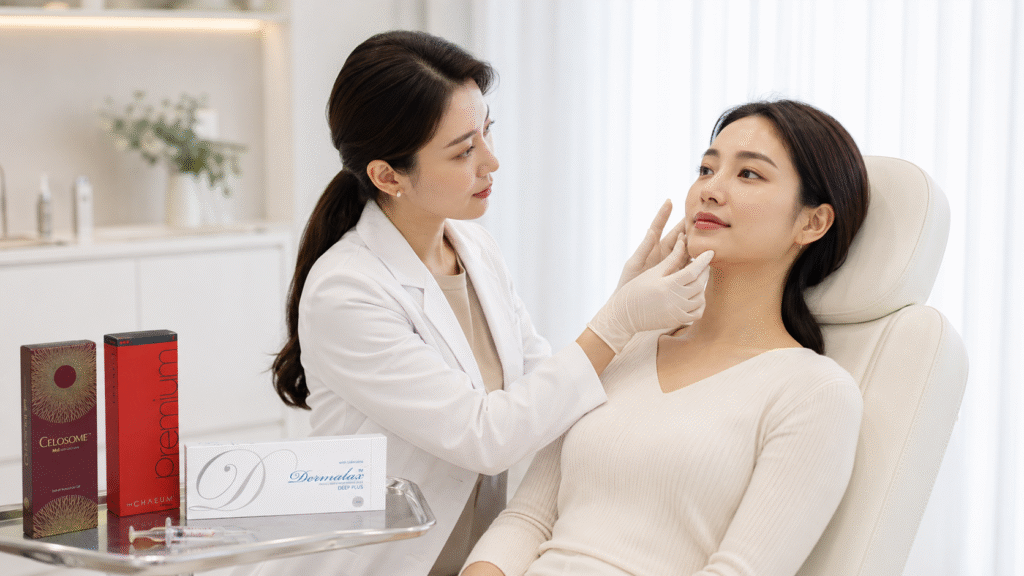
- Graduated density ranges. Chaeum Premium runs No.1 to No.4, Celosome offers Soft, Mid, and Strong, Revolax covers Fine, Deep, and Sub-Q.
- Area-specific formulation , from perioral lines to jawline projection.
- Large product families , so one brand can cover most of a clinic's needs.
- Accessible pricing – roughly $30 to $59 per unit at KoreaDerma.
Korean dermal fillers vs Korean skincare
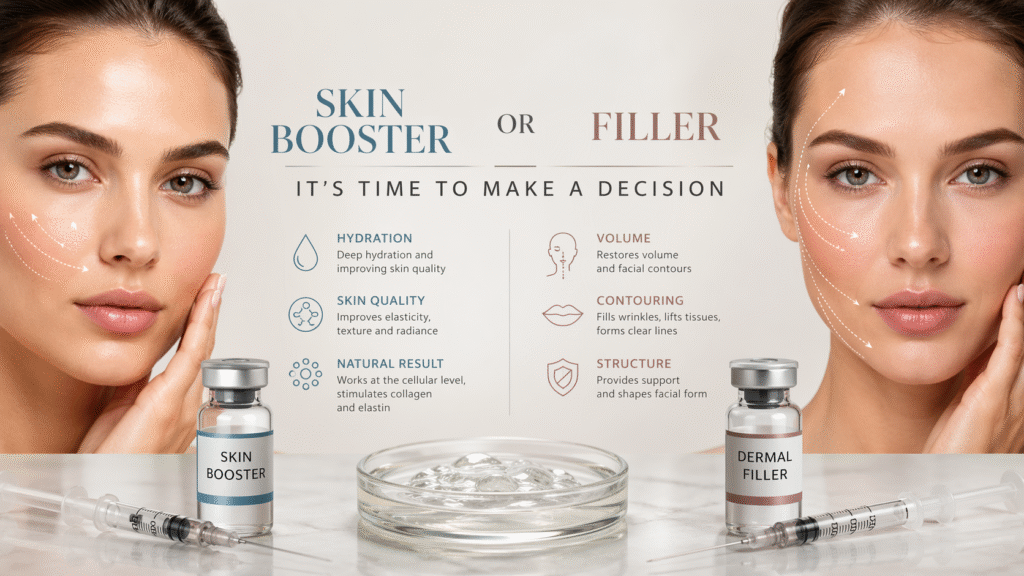
Korean cosmetics and skincare products work on the skin's surface – cleansing, moisturizing, and supporting the barrier function. Korean dermal fillers are medical products injected into the tissue, and they may only be administered by qualified specialists. Between the two sit Korean skin boosters: a skin booster is an injectable, unstabilized or lightly stabilized hyaluronic acid product spread thinly through the skin to improve hydration and skin quality, with no volumizing or lifting effect.
|
Category |
How it is used |
Main purpose |
Professional procedure |
|---|---|---|---|
|
Korean skincare |
Applied to the skin |
cleansing, hydration, daily skin care |
Usually no |
|
Skin boosters |
Injected into the skin |
skin hydration and straightforward quality |
Yes |
|
Dermal fillers |
Injected into selected areas |
correction of volume, contours, and, of course, wrinkles |
Yes |
|
Botulinum toxin products |
Injected into muscles |
temporary reduction of muscle activity |
Yes |
See also the article on the difference between skin boosters and fillers.
Are Hyaluronic acid fillers natural fillers?
Hyaluronic acid fillers are often called natural fillers, but the term is imprecise: the molecule occurs naturally in the body, while the injectable product is industrially manufactured and chemically stabilized.
The hyaluronic acid (HA) used in modern fillers is produced via fermentation rather than extraction from animal tissues – for instance, the specifications for Dermalax Deep Plus explicitly highlight the non-animal origin of its components – which is why such products are described as "natural." However, it is the cross-linking process that transforms hyaluronic acid into a filler, it binds molecular chains together, allowing the gel to retain its shape within the tissues and degrade slowly rather than breaking down in a matter of hours. The result is a medical device with precisely defined concentration, particle structure, and shelf life, often formulated with added lidocaine.
Hyaluronic acid fillers should therefore not be described as risk-free, and the label does not make them suitable for self-administration. The KoreaDerma guide to hyaluronic acid fillers covers the underlying chemistry in more depth.
Main types of Korean Hyaluronic Acid fillers
Korean HA fillers are commonly grouped as Fine, Deep, Volume, and Contour products, describing increasing density and structural capacity. These labels are not standardized: one manufacturer's "Deep" may be denser than another's, and Celosome and Chaeum Premium use their own naming systems. Manufacturer specifications take precedence over the label.
Fine fillers are the softest, most plastic gels available, formulated for superficial placement. Low viscosity lets them spread evenly through thin tissue, suiting fine lines and light lip contour definition rather than volume building. Examples include REVOLAX Fine 1.1ml, Celosome Soft with 24 mg/ml cross-linked HA and 0.3% lidocaine, CHAEUM Premium No.1, and REJEUNESSE Fine.
Deep fillers carry medium to higher density for placement in the mid to deep dermis. They address more pronounced folds – nasolabial and marionette lines are the reference points – and restore moderate volume while staying flexible in mobile areas. Examples include REVOLAX Deep 1.1ml, NEURAMIS Deep 1ml, DERMALAX Deep Plus, and Celosome Mid.
Volume fillers use a denser structure with higher elasticity, so they lift tissue and hold position rather than integrating diffusely. They restore lost facial volume and support mid-face contours, differing from soft fillers in placement depth as much as density. Options include NEURAMIS VOLUME, YVOIRE Volume, REPLENGEN Volume, and Celosome Strong.
Contour fillers provide the highest structural support in the HA range, formulated for projection in the chin, cheekbones, and jawline. Elasticity and shape retention are decisive, because the gel must withstand tissue pressure without migrating. YVOIRE Contour illustrates the profile, 1 ml per syringe, 22 mg/ml cross-linked hyaluronic acid produced with LG Chem's HICE technology, a 27G × 13 mm needle, and CE marking. REVOLAX Sub-Q and REJEUNESSE Shape serve comparable purposes.
How to choose a Korean dermal filler
Consider the treatment goal
The treatment objective allows for narrowing down the product selection faster than any other criterion. "Fine" or "Soft" category gels are suitable for correcting fine lines; lip contouring requires soft, pliable products; of course, moderate folds are corrected with "Deep" class fillers; restoring volume requires denser gels injected at greater depths; and "Contour" class products are designed for cheek and chin contouring.
Compare density and viscosity
Softer gels integrate more easily into delicate tissues, and the risk of palpable irregularities following injection is lower. Denser gels hold their shape well and withstand tissue pressure, enabling the creation of the desired volume (projection). However, high density is not an indicator of quality, using a dense gel in superficial layers represents a procedural error rather than an improvement.
Check whether the formula contains lidocaine
Lidocaine appears in many Korean dermal fillers, usually at 0.3%, to reduce discomfort during placement. It does not make a procedure painless and is not a quality indicator. Some practitioners prefer lidocaine-free gels, which is why NEURAMIS Deep No Lidocaine is stocked.
Where to buy authentic Korean dermal fillers online
Authentic Korean dermal fillers can be ordered online from KoreaDerma.shop, a specialized store offering Korean aesthetic medical products for international customers.
The store’s product range focuses on supplies for Korean aesthetic medicine rather, than standard cosmetics. The catalog includes dermal fillers, botulinum toxin products, skin boosters, injectables for body contouring and skin whitening, anesthetic creams, and consumables. Orders are shipped from South Korea via FedEx, and customers receive a tracking number. Product pages list ingredients, syringe volume, package contents, and indications for professional use, customer support is available via phone, email, or WhatsApp during business hours (Korea Standard Time). For clinics, a practical advantage is the ability to purchase everything needed in one place, a single shipment can include various types of gels (soft, deep, volumizers, and contouring products) from different brands.
Requirements for HA fillers should not be applied to botulinum toxin products, which have separate storage and transport conditions. See how to receive and store Korean aesthetic products properly.
F A Q
What are Korean dermal fillers?
Korean dermal fillers are professional injectable gels manufactured in South Korea for wrinkle correction, facial contouring, and volume restoration. Most are based on cross-linked hyaluronic acid and many contain lidocaine. They are medical devices intended for qualified practitioners, supplied in pre-filled sterile syringes of typically 1 ml or 1.1 ml.
What are the most popular Korean filler brands?
Widely used Korean filler brands include Neuramis, Revolax, Chaeum Premium, Celosome, Dermalax, and Yvoire, all stocked at KoreaDerma. The catalog also carries Rejeunesse, Replengen, Elasty, HyalDew, VOM Filler, FI-NITI, and DeneB, giving more than 50 filler items in total across soft, deep, volumizing, and contouring categories. Yvoire is manufactured by LG Chem.
Are Korean fillers made with hyaluronic acid?
Most Korean dermal fillers are hyaluronic acid fillers, though not every Korean aesthetic injectable belongs to that group. The filler category is dominated by cross-linked HA products such as Neuramis, Revolax, Celosome, and Dermalax, typically at 22 to 24 mg/ml. Skin boosters, polynucleotides, and botulinum toxins are separate categories with different mechanisms and purposes.
Which Korean filler is best for lips?
No single Korean filler is the definitive lip product – the choice depends on softness, elasticity, and each gel's stated indication. Lip work generally calls for soft to medium products that stay pliable in mobile tissue, such as REVOLAX Fine, Celosome Soft, CHAEUM Premium No.1 or No.2, and REJEUNESSE Fine. Dense contouring gels like YVOIRE Contour are not formulated for lips.
Where can I buy authentic Korean dermal fillers online?
Authentic Korean dermal fillers can be ordered online from KoreaDerma.shop. The store specializes in Korean aesthetic medical products, ships from South Korea via FedEx with tracking on every order, and lists composition, syringe volume, and package contents on each product page.
Does KoreaDerma ship internationally?
Yes. KoreaDerma ships from South Korea to most countries worldwide via FedEx. Orders are dispatched within 1-2 business days (Monday through Friday), and a tracking number is sent via email once the order has been processed. Estimated delivery times are 3-7 business days for Asia, 5-14 days for the USA and Europe, and 7-21 days for other regions. Customs duties may apply.