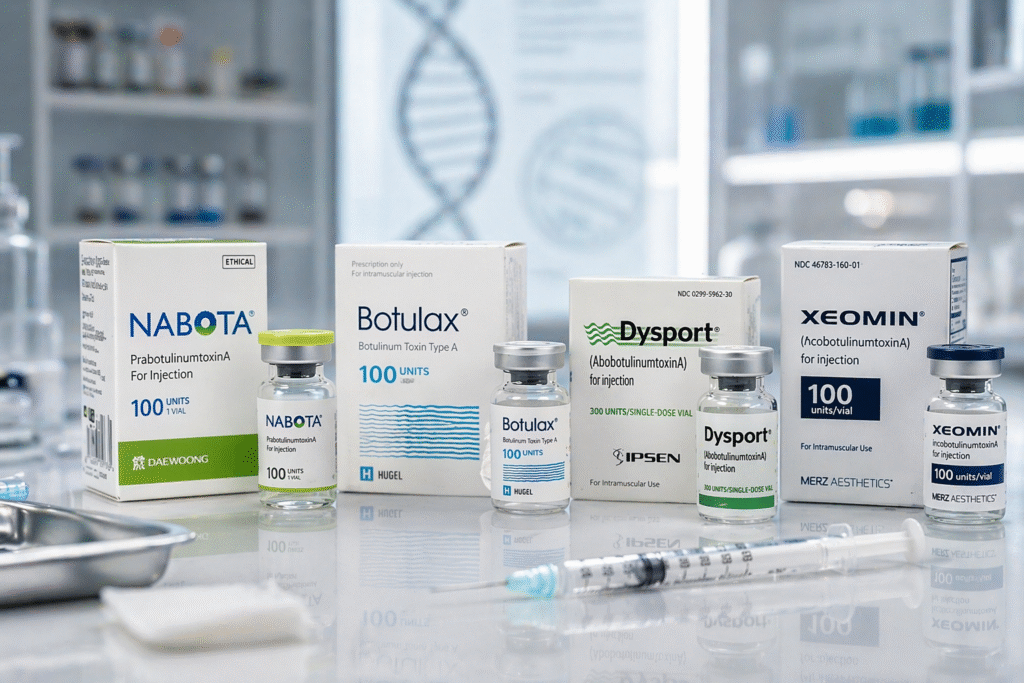
The Botox mechanism of action is a temporary reduction in nerve-to-muscle signaling. Botulinum toxin type A enters the nerve endings at the neuromuscular junction and cuts SNAP-25, a protein the nerve needs to release acetylcholine. Less acetylcholine reaches the muscle, so the selected muscle contracts less until the nerve recovers over the following months.
Korea Derma lists Korean products of this class, including Nabota, Botulax and Innotox, in its Korean botulinum toxin products category, with a separate page for each item.
Understanding Botox and botulinum toxin type A
Botox is a brand name, though many people use it for any wrinkle-relaxing injection. The name belongs to onabotulinumtoxinA, sold by Allergan Aesthetics, an AbbVie company. Botulinum toxin type A is the general term. It names a type of neurotoxin produced by the bacterium Clostridium botulinum and purified for medical use. Several companies make their own type A products, each with its own manufacturing process, formulation and potency test.
Nabota from Daewoong Pharmaceutical, Botulax from Hugel and Innotox from Medytox are Korean brands of this kind. Korea Derma lists each one as a separate product, and none of them is Botox sold under another name. Brand differences are covered in our Nabota and Botox comparison.
How botulinum toxin type A affects muscle signals
To see how botulinum toxin works, start with a normal muscle signal. Every voluntary movement begins with a message from a motor nerve. At the neuromuscular junction, where a nerve ending meets a muscle fiber, the nerve releases acetylcholine. This chemical messenger (neurotransmitter) crosses a narrow gap, binds to receptors on the muscle and makes it contract.
Acetylcholine is stored inside tiny sacs called vesicles. To release it, a vesicle has to fuse with the membrane of the nerve ending. A group of proteins called the SNARE complex pulls the two membranes together. SNAP-25, short for synaptosomal-associated protein of 25 kDa, is one of its three core parts, along with syntaxin and synaptobrevin. You can picture it as one side of a zipper that closes the vesicle onto the membrane so its contents spill out.
Botulinum toxin type A binds to nerve endings that release acetylcholine and is taken inside them. Its light chain, an enzyme, then cuts SNAP-25. A cut SNAP-25 cannot support normal vesicle fusion, so less acetylcholine is released and the muscle receives a weaker signal. Section 12.1 of the BOTOX Cosmetic prescribing information describes this sequence, and a 2017 review in Pharmacological Reviews explains each step in detail.
In aesthetic practice, this effect is used on expression lines, such as frown lines between the brows. These lines form because the same muscles contract many times a day, so a weaker contraction makes them less visible.
Why the effect is temporary
The toxin does not destroy the nerve or the muscle. In the weeks after an injection, the affected nerve grows small new branches, called sprouts, that make temporary contact with the muscle. Later the original nerve ending regains its ability to release acetylcholine, the extra sprouts are removed, and muscle activity gradually returns.
The same review gives about 3 to 4 months as the usual duration in humans. Product labels state their own figures for specific uses. The BOTOX Cosmetic label, for example, puts the effect on glabellar (frown) lines at approximately 3 to 4 months. This metric applies to a specific product and a specific indication for use. For other brands, the onset and duration of action depend on the product itself, the area being treated, the dosage, and the individual characteristics of the patient, therefore, one should consult the documentation for each specific product.
Korean botulinum toxin products at Korea Derma
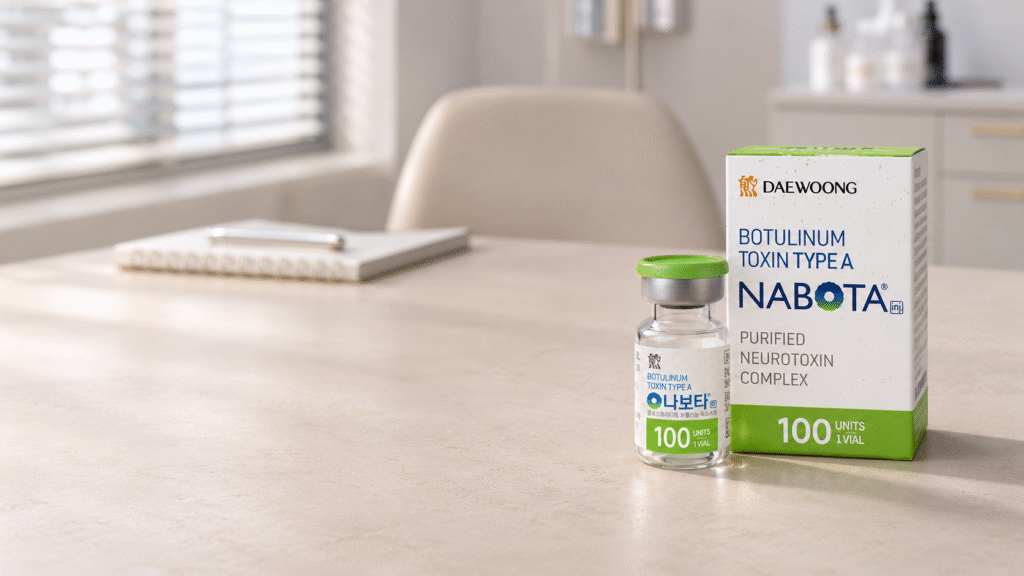
The Toxins category at Korea Derma includes three well-known Korean type A brands. The table shows the manufacturer and general form of each item. Each product name opens its page in the catalog.
| Product at Korea Derma | Manufacturer | Form |
|---|---|---|
| Nabota 100 units | Daewoong Pharmaceutical | Freeze-dried (lyophilized) powder |
| Botulax 100 units | Hugel | Freeze-dried (lyophilized) powder |
| Innotox 50 units | Medytox | Ready-to-use liquid |
The numbers 100 and 50 refer to the units in one vial. They are not treatment doses.
All three products contain botulinum toxin type A and share the same mechanism of action, as described above. However, they differ in terms of their composition, physical form, and labeling. Nabota and Botulax come as a dry powder, that must be reconstituted before use, whereas Innotox is supplied in liquid form. Each manufacturer measures potency with its own test, so a unit of one brand does not equal a unit of another. The BOTOX Cosmetic label states that its units cannot be compared to or converted into units of other botulinum toxin preparations. Korean brands use their own test methods too, so their units should also be read product by product.
Consider each preparation individually. Examine its composition, the number of units per vial, the approved indications for use, and the storage conditions as specified on the manufacturer’s labeling. The fact that two preparations share a common mechanism of action does not make them clinically interchangeable, nor does it imply that they will yield the same outcome.
Professional use and product authorization
Botulinum toxin products are medicinal preparations intended for use by licensed professionals. Before purchasing, ensure that the specific product – in its corresponding packaging – is approved for use in the country where it will be administered. In the United States, the FDA approved Jeuveau (prabotulinumtoxinA-xvfs), which is made by Daewoong and marketed by Evolus. That approval covers the registered Jeuveau packaging. It does not extend to Korean Nabota cartons. Any toxin can cause unwanted reactions, so treatment belongs with a qualified specialist. Read more about Korean botulinum toxin safety.
Frequently asked questions
How does botulinum toxin type A reduce muscle activity?
Botulinum toxin type A reduces muscle activity by weakening the nerve signal. It enters the nerve endings that supply the injected muscle and cuts SNAP-25, a protein needed to release acetylcholine. With less acetylcholine reaching the muscle, contractions become weaker until nerve function recovers, usually over several months.
What role does SNAP-25 play in the mechanism of action?
SNAP-25 is the target of botulinum toxin type A. Together with syntaxin and synaptobrevin, it forms the SNARE complex that lets acetylcholine vesicles fuse with the nerve membrane and release their contents. When the toxin cuts SNAP-25, this fusion step is impaired, so less acetylcholine reaches the muscle.
Do Nabota, Botulax and Innotox share a general mechanism of action?
Yes. Nabota, Botulax and Innotox all contain botulinum toxin type A, which cuts SNAP-25 and reduces acetylcholine release. These are distinct products manufactured by the companies Daewoong, Hugel, and Medytox, they differ in their composition and the methods used to assess their potency. The units of measurement for each are specific to the individual product, therefore, the fact that they share a common mechanism of action does not make them interchangeable or identical in their effect.
Which Korean botulinum toxin products can professionals view at Korea Derma?
Professionals can view Nabota 100 units, Botulax 100 units and Innotox 50 units in the Korea Derma Toxins category, along with other Korean type A brands. Each product page lists units per vial, package contents and shipping notes. Korea Derma ships from South Korea and can confirm availability for a specific country on request.
Compare Korean toxins at Korea Derma
Open the Toxins category at Korea Derma to compare Nabota, Botulax, Innotox and other Korean brands on their product pages. Before ordering, confirm that the product is authorized for use in your country, then contact Korea Derma about current stock and delivery.