The latest trends in Korean dermal filler treatments point in four directions: natural-looking contouring built around individual facial balance, more targeted selection of hyaluronic acid (HA) gel properties, PDLLA and HA hybrid biostimulators, and skin quality addressed as a separate goal with polynucleotide (PN) skin boosters. Exosome products are discussed alongside these trends, but they form an adjacent category with its own evidence and regulatory questions.
None of these directions is entirely new, what defines Korean dermal filler trends in 2026 is a closer match between product class and goal. Korea Derma (koreaderma.shop) stocks an example of each class, so clinic buyers can compare composition and pack sizes before ordering.
Natural-looking contouring and facial balance
Today, a natural-looking result from the use of fillers is determined by an individual’s unique facial features rather than by a single, standardized aesthetic template. When selecting a product, the focus shifts from the question of “how much volume to use” to “which specific gel is best suited for a particular patient and a particular area.”
A 2026 international consensus in the Journal of Cosmetic Dermatology, developed by a multidisciplinary panel that included practitioners from South Korea, gives this idea a structure. Its Natural Outcomes Framework assesses HA filler results by how they look, how they feel to the touch, how the patient experiences them and how the face moves in expression. Safety is the foundation, and the panel groups contributing factors into product, patient and injector factors, summed up as “treat the patient, not the photograph.”
The consensus is an expert framework, not a national survey of Korean practice or evidence of sales growth. No brand name guarantees a natural-looking result on its own: the outcome depends on the product, the patient and the qualifications of the treating specialist. Requests such as “cherry lips,” a rounded lip style discussed online, are a style preference, not a standard of care or a nationwide trend.
For buyers, this trend starts in our Korean dermal fillers category, where HA gels can be compared by documented specifications rather than by name alone.
More targeted selection of HA filler properties
One universal HA filler rarely suits every indication, so selection starts with gel properties and formulation. Buyers compare rheology, composition and labeled indications before brand familiarity.
Rheology describes the behavior of a gel when subjected to a force. G′ (G-prime)—the elastic modulus – indicates how strongly the gel resists deformation: a higher G′ value generally indicates a firmer gel, that retains its shape, while a lower value indicates a softer and more flexible gel. Viscosity, cohesiveness, hyaluronic acid concentration, degree of cross-linking, lidocaine content, and the manufacturer’s indicated uses round out the overall picture. Rheological parameters are comparable only under documented test conditions, which is why we do not rank products based on individual figures.
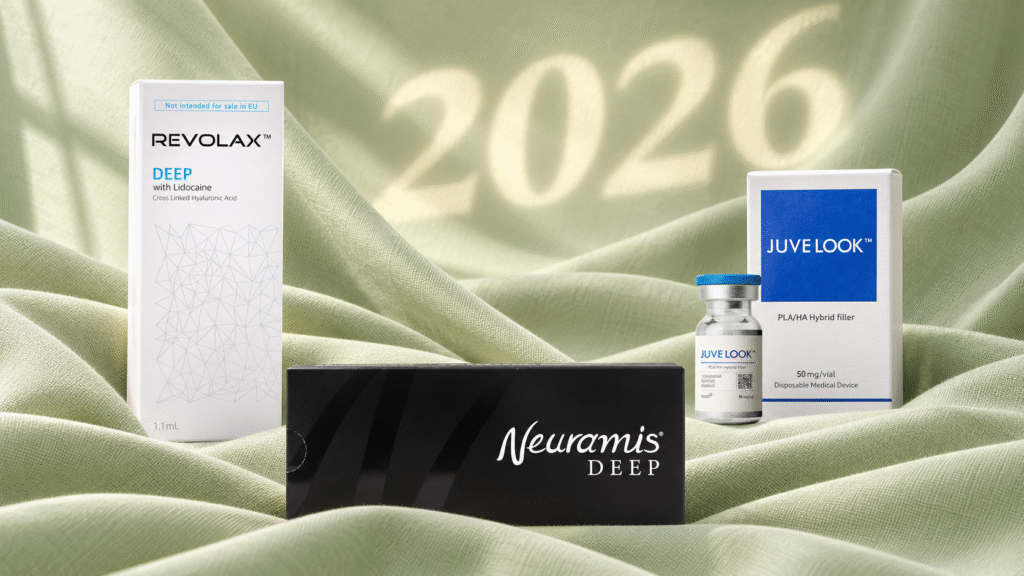
Two HA fillers in our catalog show how specifications differ within one class. REVOLAX Deep 1.1ml is a cross-linked HA filler with lidocaine, a local anesthetic, in a 1.1 mL syringeб NEURAMIS Deep No Lidocaine 1ml is a lidocaine-free HA filler in a 1 mL syringe. Names such as Fine, Deep or Sub-Q are line labels, not instructions: indications come from the manufacturer’s documentation and the specialist’s assessment. For basic product types, see our overview of Korean filler types and brands.
PDLLA and HA hybrid biostimulators
PDLLA and HA hybrids belong to a different class from classic cross-linked HA fillers. A cross-linked HA filler adds volume through the gel itself, while a PDLLA-based product is positioned around a gradual collagen-stimulating response.
PDLLA (poly-D,L-lactic acid) is a biodegradable polymer. Interest in PDLLA-based collagen stimulators stems from the fact that changes occur gradually, rather than immediately at the time of the procedure. The body’s response can vary depending on the patient, the treatment protocol, and the practitioner, therefore, results are not the same for everyone and cannot be guaranteed.
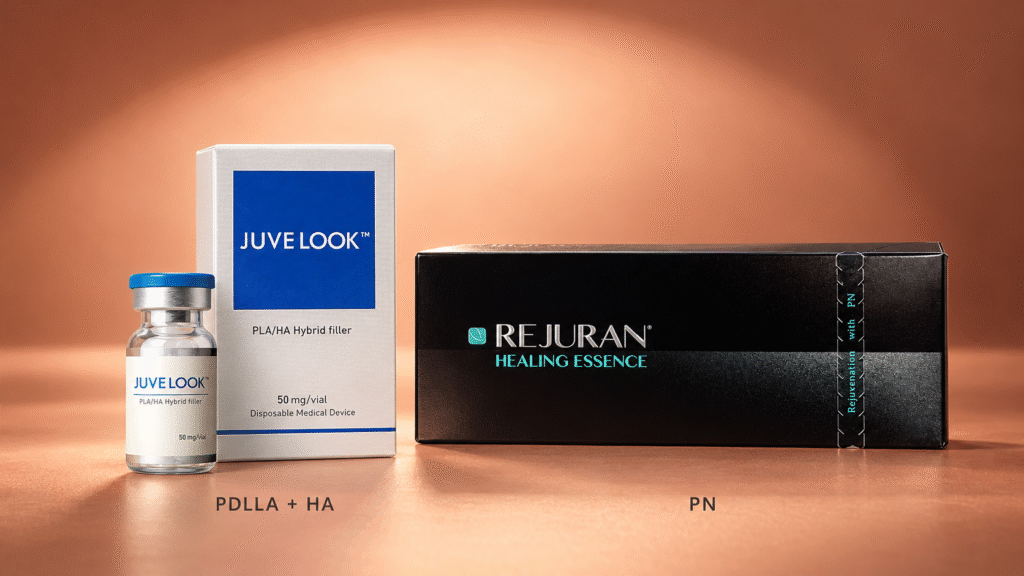
Our product example is JUVE LOOK, which we stock as the 50 mg vial. The manufacturer lists 42.5 mg of PDLLA and 7.5 mg of HA for JUVELOOK 50 mg and states the line’s intended use as temporary improvement of facial wrinkles in adults (JUVELOOK product information). Other versions, such as JUVELOOK Volume, contain different amounts, so data should not be transferred between versions; buyers should check the exact version on the label.
In comparisons of Juvelook vs HA fillers, reversibility is one practical difference. Hyaluronidase can break down cross-linked HA, which is why HA fillers are often called adjustable, but that property does not make the PDLLA component reversible.
Fillers and PN skin boosters in combined plans
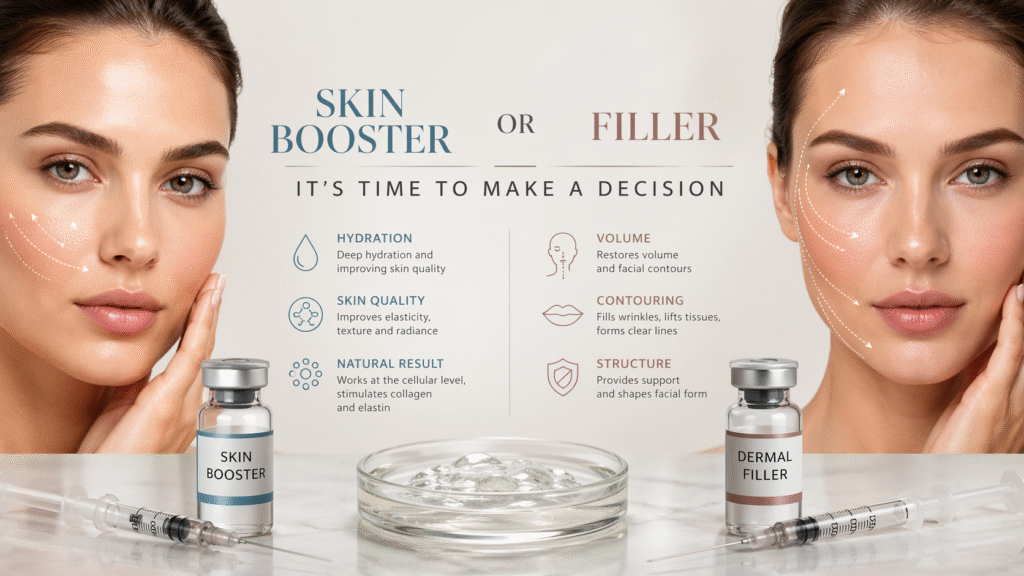
Within the framework of comprehensive treatment approaches, these two objectives are distinguished: hyaluronic acid (HA)-based fillers are used for structural correction, while polynucleotide (PN)-based boosters are employed to improve skin quality. This clear delineation of goals helps consumers select the appropriate products from the relevant category for each specific need.
PN stands for polynucleotide. It is related to PDRN (polydeoxyribonucleotide), but they are not the same component, furthermore, both differ from hyaluronic acid (HA)-based fillers in terms of both composition and intended use.
Our catalog example is REJURAN HEALER PN (2 mL × 2 syringes). The manufacturer, PharmaResearch, lists PN as the main ingredient and states the intended purpose as temporary improvement of facial wrinkles (REJURAN product information). This injectable product does not fall into the category of PDRN-based products, it should not be confused with topical products from the REJURAN brand. Similar products can be found in the Korean skin boosters section.
In a survey of 235 Korean board-certified dermatologists (Journal of Cosmetic Dermatology, online 2023, print 2024), 88% reported practicing PN injection, facial fine lines were the most common indication, and 79% of PN users reported combining PN with device-based treatments, most often radiofrequency and high-intensity focused ultrasound (HIFU). The survey was funded by PharmaResearch, the maker of REJURAN. It describes practice patterns, not clinical-trial results or 2026 market data, and it does not prove that any combination is superior or synergistic.
A combined plan does not mean mixing an HA filler and a PN product in one syringe or performing both treatments on the same day. Sequencing is a clinical decision based on each product’s documentation.
Exosomes as an emerging adjacent category
Exosome-based products are not hyaluronic acid fillers and do not replace the structural function of hyaluronic acid. While they are mentioned in discussions regarding skin quality, they require separate analysis from the perspectives of evidence-based medicine and regulation.
Exosome products exist in topical and injectable formats, and data for one format or formulation does not carry over to another. In the United States, the FDA states that exosome products intended to treat diseases or conditions require approval and that there are currently no FDA-approved exosome products (FDA consumer alert). Exosome injections should not be presented as routine therapy there, and each product should be assessed on its own composition, format and permitted use.
Sourcing Korean fillers and boosters from Korea Derma
Korea Derma is an online store for professional aesthetic products, shipped directly from South Korea. Product cards show the product name, key ingredients and pack size. That makes it possible to compare variants, such as an HA filler with or without lidocaine, or to confirm that a vial or syringe count matches a purchase plan. When a detail is unclear, buyers can ask our team about a product or an order before placing it.
Orders ship from South Korea by FedEx, with tracking provided for every order. Orders are packed and shipped within 1–2 business days; that is the processing and dispatch window, not the delivery time. Delivery estimates by region and other terms are listed on our shipping information page.
We guarantee the authenticity of the products we sell and source them from trusted Korean manufacturers and official distributors. Our catalog is intended for qualified aesthetic professionals.
Frequently asked questions
What are the latest trends in Korean dermal filler treatments?
Key trends include natural facial contouring based on balancing facial features, a more targeted selection of hyaluronic acid-based gel properties, biostimulators composed of PDLLA and hyaluronic acid hybrids, and polynucleotide (PN) boosters for improving skin quality. Exosome-based products are considered a related category, involving specific issues concerning evidence-based medicine and regulation.
Is REJURAN PN the same as a hyaluronic acid filler?
No. REJURAN HEALER PN is a polynucleotide (PN) product, while HA fillers are based on hyaluronic acid. The two differ in composition and purpose: PN is discussed for skin quality, HA fillers for structural correction. PN is also distinct from PDRN.
How does JUVE LOOK differ from a traditional HA filler?
JUVE LOOK combines PDLLA and HA; the manufacturer lists 42.5 mg PDLLA and 7.5 mg HA in the 50 mg version. A traditional HA filler adds volume through the gel itself, while JUVE LOOK is positioned around gradual collagen stimulation. Hyaluronidase does not dissolve PDLLA.
Can skin boosters replace dermal fillers?
Not as a rule. Skin boosters such as PN products are discussed for skin quality, while dermal fillers are used for structural correction such as volume and contour. The right category depends on the treatment goal, the product’s documentation and the specialist’s assessment.
Where can professionals compare Korean fillers and skin boosters?
Professionals can compare them in the Korea Derma catalog at koreaderma.shop. The Fillers category includes REVOLAX Deep and NEURAMIS Deep No Lidocaine, and the Skin Boosters category includes REJURAN HEALER PN and JUVE LOOK, with ingredients and pack size on each card.