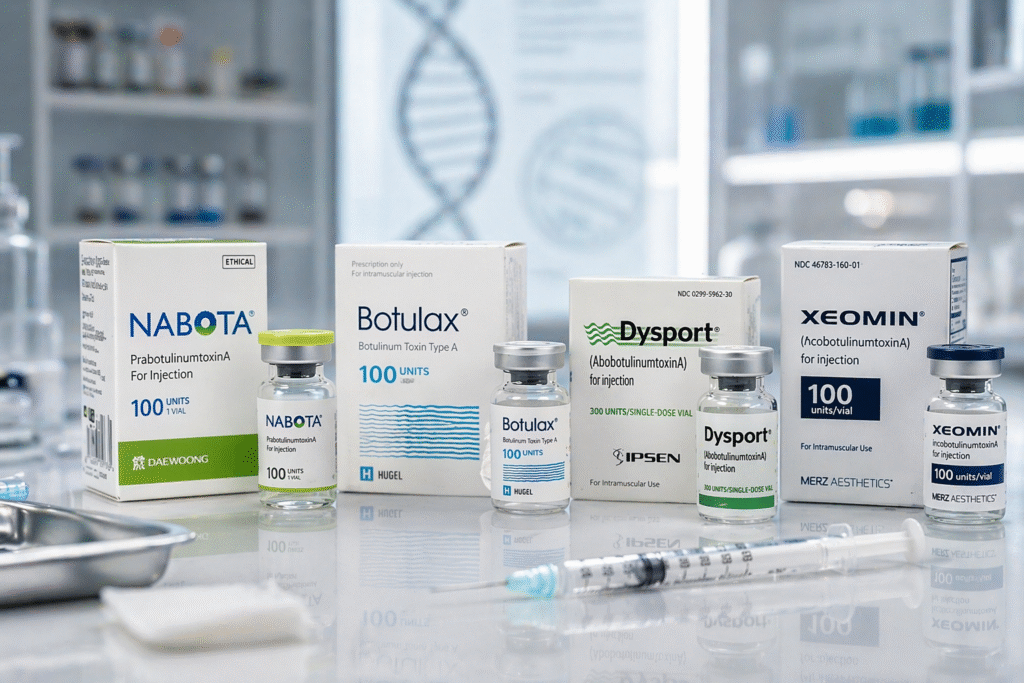
The latest research on botulinum toxin points in three directions. The strongest evidence supports onabotulinumtoxinA for preventing headaches in adults with chronic migraine. Results for essential tremor are mixed, with a positive 2026 meta-analysis and a negative 2026 trial. In aesthetics, new trials test specific formulations, such as a liquid relabotulinumtoxinA for frown lines.
This review is published by KoreaDerma, a supplier of Korean aesthetic products that also writes guides for clinics. It covers 2025 and 2026 studies of botulinum toxin type A (BoNT-A): what each one measured and how far its results reach. Sources checked November 20, 2026.
What recent botulinum toxin studies found
The newest studies support BoNT-A for chronic migraine, show smaller or uncertain effects for tremor and neck pain, and test single products in aesthetics. Each row below links to the study it summarizes.
|
Research area |
Study design and population |
Main finding |
Limitation |
|---|---|---|---|
|
Chronic migraine, adults |
Umbrella review of 14 systematic reviews with meta-analysis, Toxins, January 2026 |
Favorable effects of BoNT-A over placebo for chronic migraine; no consistent benefit for episodic migraine |
Searches ended August 2024; many trials appear in several reviews |
|
Upper limb essential tremor |
Meta-analysis of placebo-controlled RCTs, Frontiers in Neurology, August 2026; 231 participants in the main analysis |
Lower clinician-rated tremor severity at 4 to 6 weeks; more muscle weakness, lower grip strength |
Two to four trials per outcome; an October 2026 RCT missed its primary endpoint |
|
Persistent neck pain |
Cochrane review, 16 trials, 855 people, May 2026 |
Slight short-term pain relief vs saline (about 6%) |
No clear long-term, function or well-being benefit; mostly industry-funded trials |
|
Glabellar lines |
Phase 3b RCT of liquid relabotulinumtoxinA vs placebo, 132 adults, published November 10, 2026 |
92.9% vs 9.1% rated their lines improved at month 1 |
Placebo comparator only; results apply to one product |
Results obtained for a specific molecule for a given indication cannot be automatically extrapolated to another product. In the United States, the prescribing information for BOTOX lists the prevention of headaches in adults with chronic migraine as an approved indication, however, the same document notes that the safety and efficacy of the product for episodic migraine have not been established. Indications, units of activity, and warnings are determined individually for each product, therefore, physicians should consult the prescribing information for the specific product available in their market.
Evidence for neurological conditions and pain
For neurological uses, the evidence is most consistent in chronic migraine, mixed in tremor and modest for neck pain and neuralgia.
Chronic migraine
BoNT-A outperformed placebo for preventing chronic migraine but not episodic migraine. The January 2026 umbrella review pooled 14 high-quality systematic reviews and found lower headache frequency, severity and acute medication use in chronic migraine. For episodic migraine, most frequency outcomes were small and showed no clear difference from placebo. In the US, this indication belongs to onabotulinumtoxinA in adults with 15 or more headache days a month.
Upper limb essential tremor
Tremor results point in different directions. The August 2026 meta-analysis rated short-term tremor reduction as probable (moderate certainty), with more muscle weakness and lower grip strength at low certainty. In October 2026, a phase 2 trial of incobotulinumtoxinA funded by Merz Therapeutics randomized 78 adults, change in wrist tremor amplitude at week 6 numerically favored placebo (p = 0.28). Treatment-related weakness occurred in 24% of the active group and none of the placebo group. The meta-analysis included this trial’s registry results, so the two sources share data.
Persistent neck pain and neuralgia
For neck pain, the effect is minor and short-lived. A Cochrane review notes that botulinum toxin type A (BoNT-A) may provide a slight reduction in pain – for a maximum of about three months – while having virtually no impact on daily activities. Most of the trials were funded by manufacturers. For trigeminal and postherpetic neuralgia, a 2026 meta-analysis of 7 RCTs with 368 participants reported lower pain scores, mostly at 8 to 12 weeks. Only two trials ran longer, and the estimate beyond 24 weeks was uncertain, with a confidence interval crossing zero.
What the studies mean for aesthetic practice
Recent aesthetic trials test single formulations, so each result belongs to the product that was studied.
Liquid formulations studied for glabellar lines
Ready-to-use botulinum toxin is an active research area. The trial published on November 10, 2026, in Plastic and Reconstructive Surgery was the Galderma phase 3b RELAX study of liquid relabotulinumtoxinA in adults with moderate to severe glabellar lines (99 treated, 33 placebo). It measured patient-rated aesthetic improvement, clinician-rated line severity, satisfaction and safety. At month 12, 37.8% of treated participants still rated their lines improved, while 12.2% kept at least a one-grade gain on the clinician scale. Twelve months was the follow-up period, not a measured duration of effect. Treatment-related adverse events, all mild, occurred in 8.1%.
A 2025 JAMA Dermatology trial took another approach. This single-center RCT in 143 women compared four US-approved products, including prabotulinumtoxinA as sold in the US under the name Jeuveau, using 3D measurement of glabellar strain. Onset and day-180 results differed between products.
Why treatment response can decline
Primary nonresponse means a patient never responds. Secondary nonresponse means an earlier response fades with later treatments. Neutralizing antibodies are one possible cause. A 2025 narrative review in JMIR Dermatology also lists treatment intervals, injection technique, handling and patient factors, and notes that prevalence data in aesthetics are limited. A 2025 meta-analysis funded by Merz reported failure and antibody rates in neurological indications. Those patients receive different doses and schedules, so the rates cannot be used to estimate aesthetic risk. Our Korean botulinum toxin safety guide covers safety in more detail.
What studies of the jaw muscles found
Jaw muscle studies are small and mostly uncontrolled, and each result applies only to the group studied.
Myotonometry is a research method that measures the mechanical properties of a muscle, such as tone, stiffness and elasticity, with a probe placed on the skin. A 2025 longitudinal study used it on the masseter in 57 adults aged 18 to 40 with symptoms of bruxism. Three weeks after BoNT-A injection, tension and stiffness during clenching fell and elasticity rose. By three months, most values had moved back toward baseline, except in patients with the highest starting values. The study had no control group.
The GRASP cohort asked a different question. In 58 adults with chronic migraine and comorbid bruxism, onabotulinumtoxinA cycles that included masseter injections were followed by a 50% or greater drop in monthly headache days in 41 patients (70.7%). Bruxism pain scores also fell. Without a control group, the study cannot show which part of the treatment produced which change.
For oromandibular dystonia, a 2024 meta-analysis of 26 studies and 1,103 patients reported improvement in most treated patients, with high heterogeneity between studies (I² = 85%). Adverse effects were reported in 17.8% of patients, most often difficulty swallowing.
None of these studies measured jawline shape in healthy adults. That topic is covered in our guide to masseter toxin and jawline shape.
Safety and product labeling
Adverse reactions depend on the product and the indication, so the label for that exact product is the reference. On the BOTOX label for chronic migraine, eyelid ptosis was reported in 4% of treated patients vs less than 1% with placebo, and neck pain is among the most common reactions.
Every US botulinum toxin label carries a boxed warning: the toxin effect may spread beyond the injection site and cause generalized weakness, double vision, drooping eyelids, and swallowing or breathing problems, hours to weeks after injection. Swallowing and breathing problems can be life threatening, and FDA advises immediate medical care if they appear.
Potency units are specific to each product and its assay (JEUVEAU label). The same unit count printed on two vials does not show that the products are equivalent. In November 2025, FDA sent 18 warning letters to websites selling unapproved and misbranded botulinum toxin and warned that products from unauthorized sources may be counterfeit, contaminated or improperly stored.
Korean botulinum toxin products at KoreaDerma
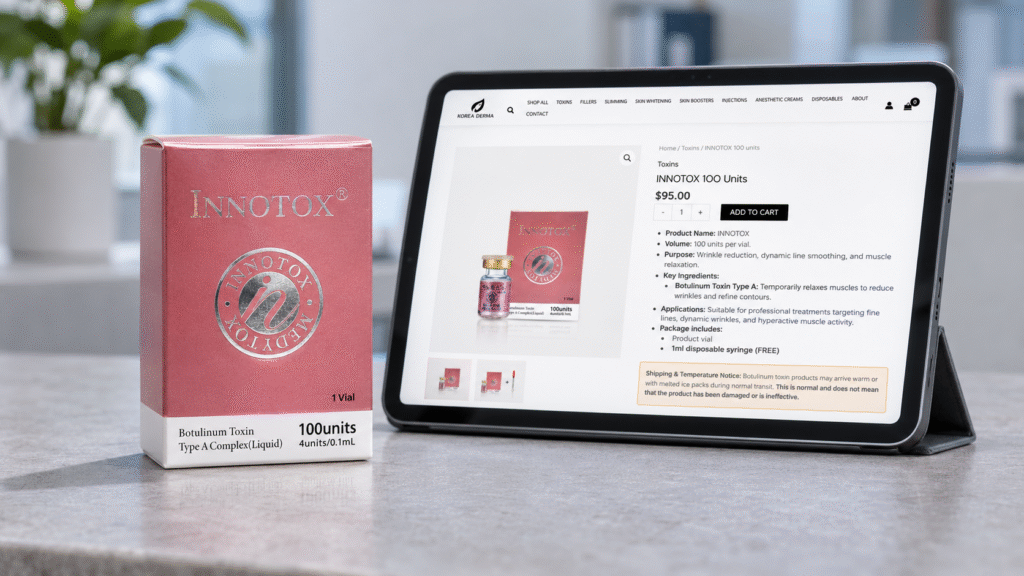
KoreaDerma lists Korean BoNT-A products in freeze-dried and ready-to-use liquid forms, and each product card states the name, form and vial size.
Because the research above is tied to specific formulations, the first check on any product is its exact name, form and units per vial. KoreaDerma ships orders from South Korea and shows these details on each card. The examples below apply to markets where the product and the supply channel have been confirmed.
|
Product card |
Manufacturer |
Form |
What to check |
|---|---|---|---|
|
Nabota 100 units |
Daewoong Pharmaceutical |
Freeze-dried powder, 100-unit vial |
US approval of Jeuveau is tied to its exact US labeling |
|
Botulax 100 units |
Hugel |
Freeze-dried powder, 100-unit vial |
The label and status of Botulax itself in your market |
|
Innotox 100 units |
Medytox |
Ready-to-use liquid, 100-unit vial, per the catalog card |
RelabotulinumtoxinA trial results do not apply to it |
These Korean-labeled products are not FDA-approved. An FDA warning letter from November 2025 names a product sold as Nabota as an example of an unapproved botulinum toxin, and FDA import rules apply to every drug entering the US. US clinics use FDA-approved products from authorized channels.
In markets where the products are authorized, clinics can compare cards in the Korean botulinum toxin catalog, where prices and stock are listed. KoreaDerma packs toxins in insulated packaging with ice packs and warns that parcels can arrive warm in hot weather; see KoreaDerma shipping information before ordering. Questions about labeling or documentation can go through the KoreaDerma contact page.
Read KoreaDerma’s guide to Korean aesthetic products
Frequently asked questions
Does botulinum toxin help prevent chronic migraine?
Yes, in adults with chronic migraine. A 2026 umbrella review of 14 systematic reviews found benefit over placebo, and in the US the indication belongs to onabotulinumtoxinA. The BOTOX label states that benefit in episodic migraine has not been established.
Are liquid botulinum toxin products interchangeable?
No. Liquid products differ in molecule, formulation, potency assay and approved indications. Compare the exact name, form, vial size, registered indication and the label for your market. Results from the relabotulinumtoxinA trial apply to relabotulinumtoxinA only.
Can botulinum toxin stop working over time?
It can. Some patients never respond, and others lose a response they once had. Neutralizing antibodies are one cause, alongside technique, handling and patient factors. A 2025 JMIR Dermatology review notes that aesthetic data on this are limited.
Does FDA approval of Jeuveau apply to Nabota?
No. FDA approval covers Jeuveau (prabotulinumtoxinA-xvfs) with its US labeling. A 2025 FDA warning letter cites a product sold as Nabota as an unapproved botulinum toxin for the US.