Not every fat deposit responds to diet and exercise. A double chin, folds at the waistline, the "saddlebag" area, or volume along the jawline often persist even in people with a stable weight and an active lifestyle. It's precisely for these "stubborn" zones that a separate direction of aesthetic medicine exists – injectable lipolysis. This isn't a method of weight loss but a tool for targeted contour correction, one that has secured a firm place between cosmetology and non-surgical plastic procedures.
What injectable lipolytics are
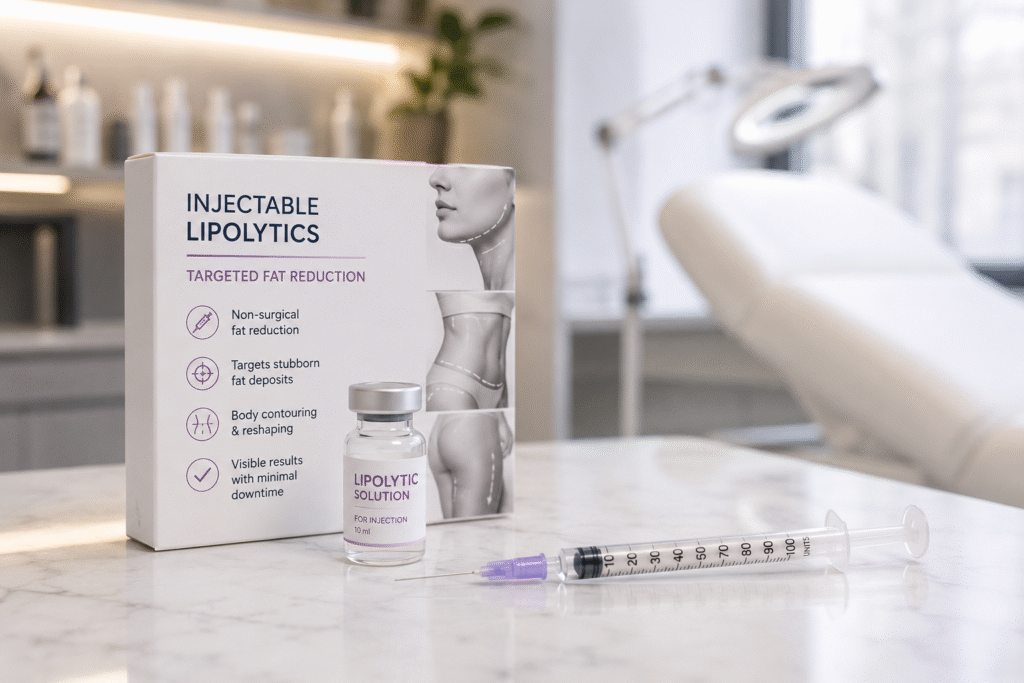
Lipolytics are products that are injected directly into the subcutaneous fat tissue to destroy or reduce localized fat deposits. Unlike systemic weight loss, they work in a targeted way, the practitioner treats a specific zone without affecting the entire body.
It's fundamentally important to understand, that lipolytics aren't intended for fighting obesity. Their task is to correct the shape where fat is distributed unevenly and doesn't go away with an overall reduction in body weight. That's why the ideal candidate for the procedure is a person with a normal or near-normal weight and localized "problem" areas.
Direct and indirect lipolysis
All injectable methods fall into two large classes, and understanding the difference between them is the foundation of competent protocol selection.
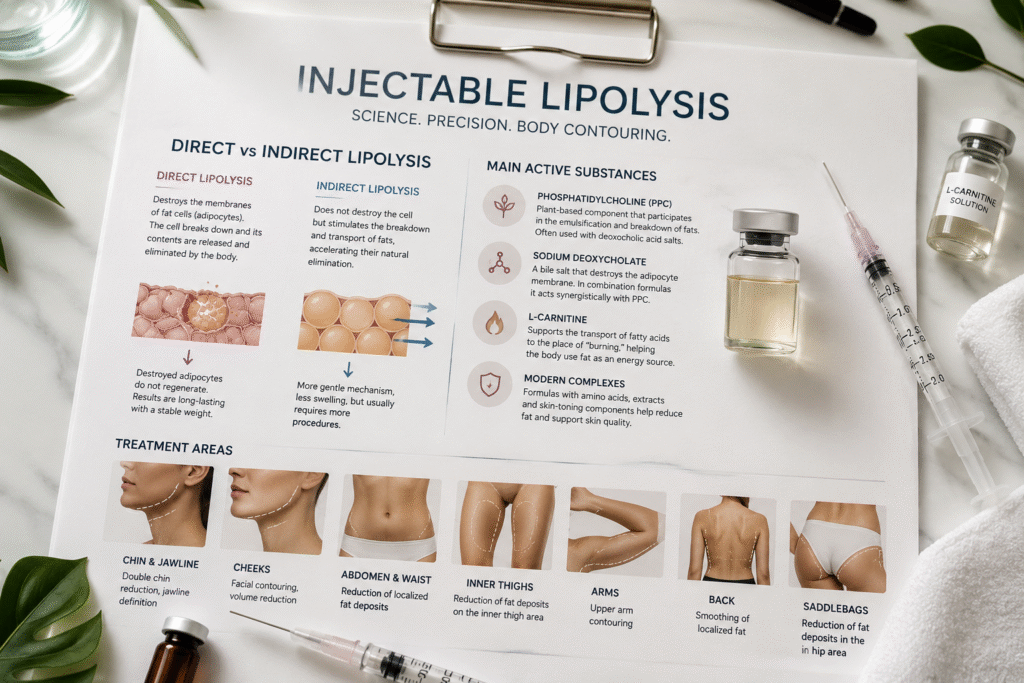
Direct lipolysis destroys the membranes of fat cells (adipocytes). The active substance causes the cell to break down, after which its contents are released and removed through the lymphatic system and metabolized by the body. The key feature of this approach is that the destroyed adipocytes don't regenerate, so with a stable weight the result lasts a long time.
Indirect lipolysis acts more gently, it doesn't destroy the cell but stimulates the breakdown and transport of fats, accelerating their natural elimination. This mechanism is considered more delicate, is less often accompanied by pronounced swelling, but usually requires a greater number of procedures to achieve a noticeable effect.
Main active substances
Behind various trade names lies a limited set of active components, and it's important for the practitioner to be oriented in those rather than in marketing formulations.
Phosphatidylcholine (PPC) is one of the most common components of direct lipolysis. It's a substance of plant origin that participates in the emulsification and breakdown of fats. It's often used in combination with deoxycholic acid salts, which enhance the destruction of cell membranes.
Sodium deoxycholate is a bile salt that destroys the adipocyte's membrane. As part of combined formulas, it works in synergy with phosphatidylcholine, providing a pronounced effect in zones of dense fat deposits.
L-carnitine is a representative of the indirect mechanism. It doesn't destroy cells but transports fatty acids to the place where they're "burned," helping the body use fat as a source of energy. Because of its gentle action, it's often included in course-based programs and combined with physical activity.
A separate group consists of modern complexes supplemented with amino acids, extracts, and components that support skin tone and reduce the risk of sagging after a reduction in volume. Such formulas address two tasks at once – they reduce the fat layer and at the same time work on skin quality, which is especially important when treating large zones.
Understanding the composition helps the practitioner not to rely blindly on the trade name but to consciously choose a product for a specific task, in some places pronounced direct lipolysis is needed, while in others a gentle course-based stimulation without swelling and a recovery period is needed.
Treatment areas
Injectable lipolysis is effective primarily in zones of localized deposits of small and medium volume. These include the area of the chin and lower jaw, where a "double chin" forms, the cheeks when it's necessary to define the line of the face, the area of the abdomen and waist, the inner surface of the thighs, the arms in the upper-arm region, the back, and the "saddlebag" area.
A separate direction is the delicate correction of the facial contour, where not a radical reduction in volume is required but fine work on the border between lipolysis and modeling.
Protocols and number of procedures
Injectable lipolysis is always carried out as a course. A single procedure almost never gives a final result, since the body needs time to eliminate the destroyed fat and gradually restructure the tissues.
The standard scheme includes from two to six sessions with an interval of two to four weeks. The exact number depends on the volume of the zone, the type of product, the chosen mechanism of action, and the individual response of the tissues. Patients usually notice the first visible changes after the second or third procedure, and they evaluate the final result a few weeks after the course is completed.
The product is injected through fine needles in a grid pattern within the area being treated. After a session, temporary swelling, mild tenderness, redness, and small lumps are possible – this is a natural tissue reaction that usually passes within a few days.
Combining with other methods
Injectable lipolysis is rarely used in isolation – more often it becomes part of a comprehensive program. A common approach is the combination with device-based methods, radiofrequency lifting, ultrasound technologies, or microcurrent therapy, which help tighten the skin after a reduction in volume.
Lipolytics are also combined with procedures that improve skin quality in order to avoid a sagging effect. In body-contouring programs, it's important to take into account not only the reduction of fat but also the condition of the skin over the treated zone – otherwise the result may look unfinished. Competent planning of the sequence and intervals between procedures directly affects the outcome.
Contraindications and precautions
Like any injectable method, lipolysis has a clear list of limitations. The absolute contraindications include pregnancy and the lactation period, acute infectious processes, blood-clotting disorders, severe liver and kidney diseases, autoimmune conditions in the acute stage, and individual intolerance to the components.
Inflammation or damage to the skin in the area of the intended injection calls for postponing the procedure. Before the course, a consultation is necessary, with the collection of a medical history and an assessment of how realistic the patient's expectations are. It's important to explain in advance that lipolytics don't replace a healthy lifestyle, with a significant weight gain, fat may appear in untreated zones.
Common misconceptions
A number of persistent myths have built up around injectable lipolysis. The first is that it's a method of weight loss. In reality, it's a tool for local contour correction, not for reducing overall body mass. The second myth is that the result is visible right away, the effect develops gradually and requires a course. The third is the idea that destroyed fat will inevitably return. With direct lipolysis, adipocytes don't regenerate, and with a stable weight the result lasts a long time. The fourth myth is that the procedure is suitable for everyone, with pronounced excess weight, injectable lipolysis is ineffective and isn't an alternative to a systemic approach.
What the practitioner should keep in mind
The result depends directly on the practitioner's qualifications, the correct selection of the product, and the precision of the injection. Before starting the course, it's important to determine the mechanism that will suit a specific patient, direct lipolysis for dense localized deposits or indirect lipolysis for gentle course-based correction.
Just as important are the authenticity of the product and compliance with storage and transport conditions. Lipolytics are sensitive to the temperature regime, and the market, unfortunately, is saturated with questionable products. It's worth working only with verified formulas from reliable suppliers that provide a complete package of accompanying documents.
Injectable lipolytics have become a practical solution for those "impossible zones" that don't respond to diet and exercise. This isn't a miracle remedy or a way to lose weight but a precise tool for contour correction with a minimal recovery period. With competent selection of the mechanism, a correct protocol, and work with quality products, lipolysis allows the practitioner to offer patients a safe and predictable alternative to surgical methods – with a natural and long-lasting result.