Korean skin boosters are a broad group of professional products aimed at skin quality, such as hydration, texture and fine lines, rather than one formula or a standardized procedure. The main classes are hyaluronic acid (HA) formulas, polynucleotide (PN) and polydeoxyribonucleotide (PDRN) products, and poly-D,L-lactic acid (PDLLA) and HA hybrids. Exosome-based products form a separate group, with a thinner evidence base and no FDA-approved products to date.
At Korea Derma, we stock examples of each class in our Korean skin booster products catalog. This guide explains how the classes differ and which specifications to compare before you order.
What are Korean skin boosters
Korean skin boosters are professional aesthetic products from Korean manufacturers designed to improve skin quality. The term is a market label, not a regulatory category: it does not guarantee a particular ingredient, the same indications or a single method of use.
A 2026 narrative review in the Journal of Cosmetic Dermatology describes skin boosters as a heterogeneous group whose evidence base varies widely between product types. Two products sold under the same label may share little beyond the goal of better skin quality.
The same word is also used for home-care cosmetics, such as serums and ampoules. These topical consumer products are not interchangeable with the professional products covered here, even when an ingredient like PDRN appears on both labels.
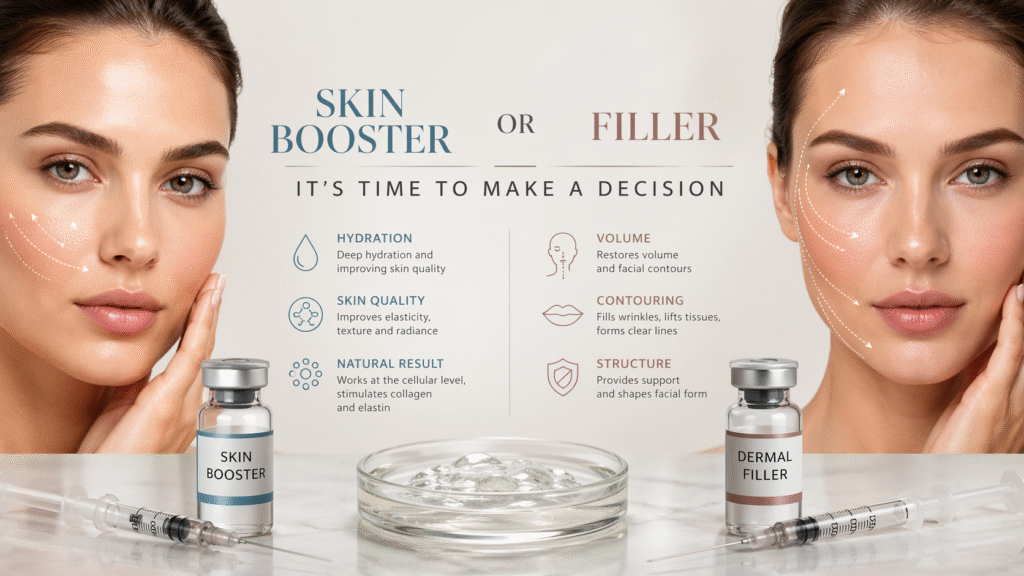
Skin boosters are often contrasted with HA fillers. Fillers are designed for structural correction and volume, while boosters focus on skin quality. The line is not absolute, and some boosters, especially biostimulators, can affect fullness to a degree. See our guide to skin boosters vs fillers.
Main types of Korean skin boosters
Korean skin boosters fall into four broad classes defined by their key ingredient. Each class relies on a different approach, so compare products within a class first and across classes second.
Hyaluronic acid and hydration-focused formulas
Products based on hyaluronic acid are the most common type of skin booster. Hyaluronic acid (HA) – often listed as sodium hyaluronate in ingredient lists – is a naturally occurring molecule capable of binding and retaining water; this is precisely why products containing HA are associated with hydration.
Not every HA product behaves the same way. Its properties depend on the formula, including molecular weight, concentration and whether the HA is cross-linked or otherwise stabilized. A lightly stabilized HA intended for skin quality differs from a dense cross-linked gel designed for contouring, so an HA filler is not automatically an example of a skin booster.
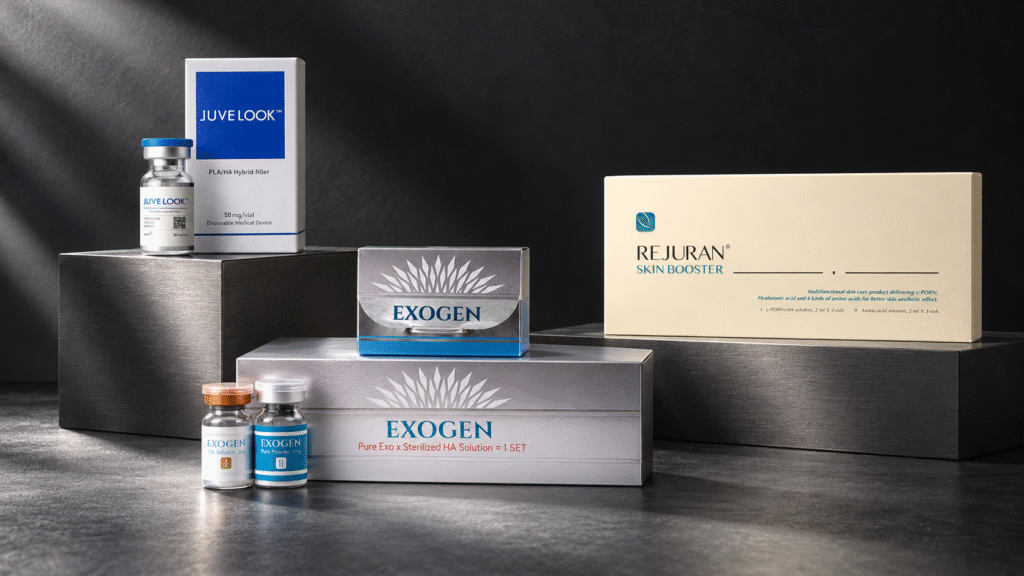
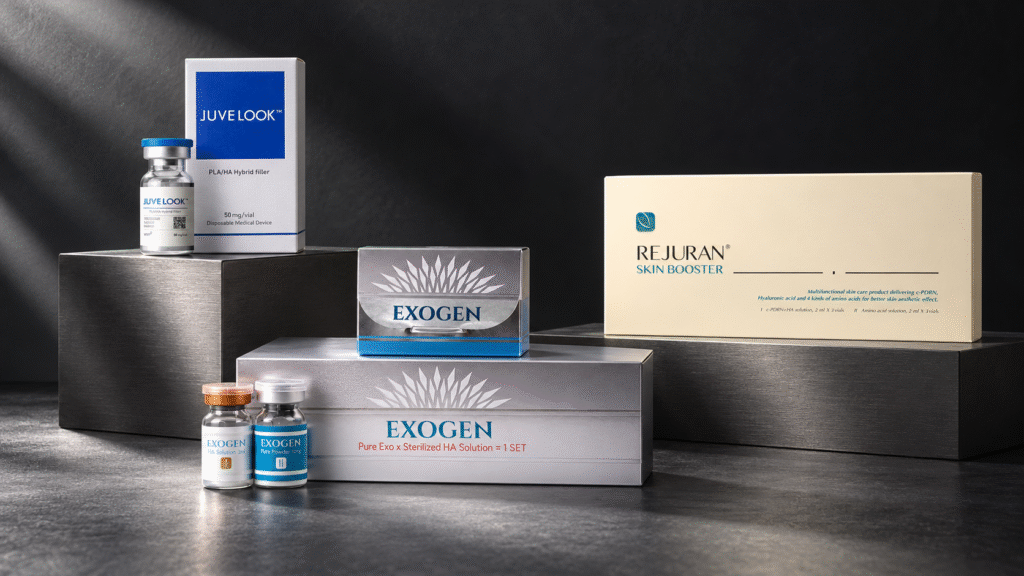
Many Korean products combine HA with other ingredients. In our catalog, for instance, hyaluronic acid (HA) is listed as an ingredient in Rejuran Skin Booster, alongside c-PDRN and amino acids.
PN and PDRN products
PN (polynucleotides) and PDRN (polydeoxyribonucleotide) are DNA-derived ingredients, typically purified from fish such as salmon. Both are fragments of nucleic acids, yet they differ in chain length and processing method, furthermore, each manufacturer provides its own definition for this component. These substances do not alter human DNA, their impact on tissue repair and skin quality is currently under active investigation, with the available evidence varying depending on the specific product and how it is applied.
For a specific product, use the manufacturer’s own term. PharmaResearch’s product information for REJURAN lists PN as the ingredient, packed as 2 cc × 2 syringes, which matches REJURAN HEALER PN in our catalog.
Rejuran Skin Booster is a different product. Its card lists c-PDRN with HA, plus a separate amino acid solution. The name REJURAN does not in itself refer to a single, specific formula: each product in the line has its own unique composition and documentation, and data pertaining to REJURAN cosmetic products for topical use do not apply to products intended for professional use.
Practice data from Korea are also available. A 2024 survey of 235 Korean dermatologists documented patterns of cosmetic PN use. The survey was funded by PharmaResearch, and it reflects clinical habits rather than proof that any PN or PDRN product outperforms another.
PDLLA and HA hybrid biostimulators
PDLLA and HA hybrids are biostimulators: they rely on a gradual tissue response rather, than immediate hydration. They form a separate class from PN/PDRN products and from hydrating formulas.
PDLLA (poly-D,L-lactic acid) is a biodegradable polymer. As a class, PDLLA products are associated with collagen stimulation, so visible changes develop gradually rather than right after a session. The degree and duration of results vary between patients and products, and there is no universal figure for how long they last.
JUVE LOOK is the example in our catalog. The manufacturer’s JUVELOOK product information lists the 50 mg version as 42.5 mg PDLLA plus 7.5 mg HA. This product line also includes other variants, such as JUVELOOK Volume (200 mg), so when comparing specifications, be sure to check the specific version and dosage.
The HA in the formula does not make the product reversible. Hyaluronidase breaks down hyaluronic acid, not the PDLLA component.
Exosome-based and other multi-ingredient products
Exosome-based products rely on extracellular vesicles, tiny membrane-bound particles released by cells, rather than on a single active such as HA, PN or PDLLA. Their evidence base is still developing.
EXOGEN by BS PHARM is the example in our catalog. The manufacturer’s EXOGEN product page lists a multi-ingredient formula with exosomes, peptides, HA, PDRN and collagen, packed as 4 sets per box. Treat this as a product specification, not as evidence of regeneration or approval for injection, and check the documentation for the intended route of use.
In a consumer alert, the FDA states that there are currently no FDA-approved exosome products. Data on one product, vesicle source or topical use should not be applied to another.
Korean skin booster products in the Korea Derma catalog
The table below brings together the four Korean skin booster products discussed above, by stated composition and pack size. The volume of a vial or syringe is a packaging detail, not a per-session dose.
|
Korean skin booster products in our catalog: stated composition and pack size |
|||
|---|---|---|---|
|
Product |
Stated composition |
Pack size |
What to distinguish |
|
REJURAN HEALER PN |
PN (polynucleotides) |
2 mL × 2 syringes |
Standalone PN product; not a substitute for Rejuran Skin Booster |
|
Rejuran Skin Booster |
c-PDRN + HA; amino acid solution (per product card) |
2 mL × 3 (c-PDRN + HA) + 2 mL × 3 (amino acids) |
Two-component kit; confirm the route of use in the documentation |
|
JUVE LOOK |
PDLLA 42.5 mg + HA 7.5 mg |
50 mg per vial |
PDLLA/HA hybrid biostimulator; not JUVELOOK Volume |
|
EXOGEN |
Multi-ingredient exosome formula with peptides, HA, PDRN and collagen |
4 sets per box |
A catalog listing does not establish an authorized route of use |
Benefits, limitations and product-specific risks
The benefits of a skin booster depend on the specific product, the outcome measured and how it was studied. Research across classes looks at hydration, texture, fine lines and other skin quality measures, but a result shown for one formula does not transfer to the whole category.
The time it takes for an effect to appear, its duration, the number of sessions required, and the recovery period can all vary. Products are studied using different application protocols, and individual bodily responses differ from person to person. Terms such as “glass skin” describe only an aesthetic appearance, rather than a standardized or guaranteed result.
Risks also depend on composition and route of use. Injectable products can cause injection-related reactions such as redness, swelling, bruising and tenderness, as well as less common but more serious complications, including infection. PDLLA products also carry a risk of nodules. With exosome products, limited data and an unsettled regulatory status add uncertainty.
Product choice, technique and aftercare belong to the treating practitioner and the manufacturer’s instructions, and a supplier’s product description is not a substitute for either.
Where to buy Korean skin boosters
You can buy Korean skin boosters online from Korea Derma, a supplier of professional aesthetic products. Our catalog brings several classes together in one place, so you can compare PN, PDRN, PDLLA/HA and exosome-based products by composition and pack size before ordering.
Each product in this guide has its own dedicated entry, specifying its exact name and version. Our team is available to answer any questions you may have regarding our product range, a specific item, or an order you have already placed. Please reach out to us if you require documentation or detailed information about a particular batch.
Orders are shipped from South Korea via FedEx, a tracking number is provided. Processing and dispatch take 1–2 business days – this refers to the time required to prepare your order, not the actual delivery time. See our shipping information for details.
Explore Korean skin booster products at Korea Derma and contact our team with product or order questions.
Frequently asked questions
What are Korean skin boosters?
Korean skin boosters are professional products from Korean manufacturers aimed at skin quality. The category includes HA, PN/PDRN, PDLLA/HA and exosome-based formulas, which differ in composition, mechanism and route of use.
Which Korean skin booster products are available at Korea Derma?
Korea Derma stocks REJURAN HEALER PN, Rejuran Skin Booster, JUVE LOOK and EXOGEN, among other products. Browse our skin boosters category to compare compositions and pack sizes, and check each product card for current availability.
How does REJURAN HEALER PN differ from JUVE LOOK?
They belong to different classes. REJURAN HEALER PN is a polynucleotide product supplied as 2 mL × 2 syringes. JUVE LOOK is a PDLLA/HA hybrid biostimulator, the 50 mg version contains 42.5 mg PDLLA and 7.5 mg HA. Their mechanisms and risks differ.
Are PN and PDRN the same in every skin booster?
No. While PN and PDRN are related components derived from DNA, they differ in terms of chain length and processing methods, furthermore, each manufacturer defines the specific ingredient they use in their own way. When comparing products, look at their precise, documented composition rather than the generic name listed on the label.
Are all skin booster products intended for injection?
No. Some products are intended for injection, while others are meant for topical application or for use in combination with aesthetic devices. The product category, a vial that looks like a professional-grade item, or the existence of a cosmetic product notification – none of these serve as confirmation that a particular method of application is permitted.
How long do skin booster results last?
There is no single answer for the category. Duration depends on the product class, the specific formula, the available evidence and individual factors. Look for study data on the exact product rather than general figures.