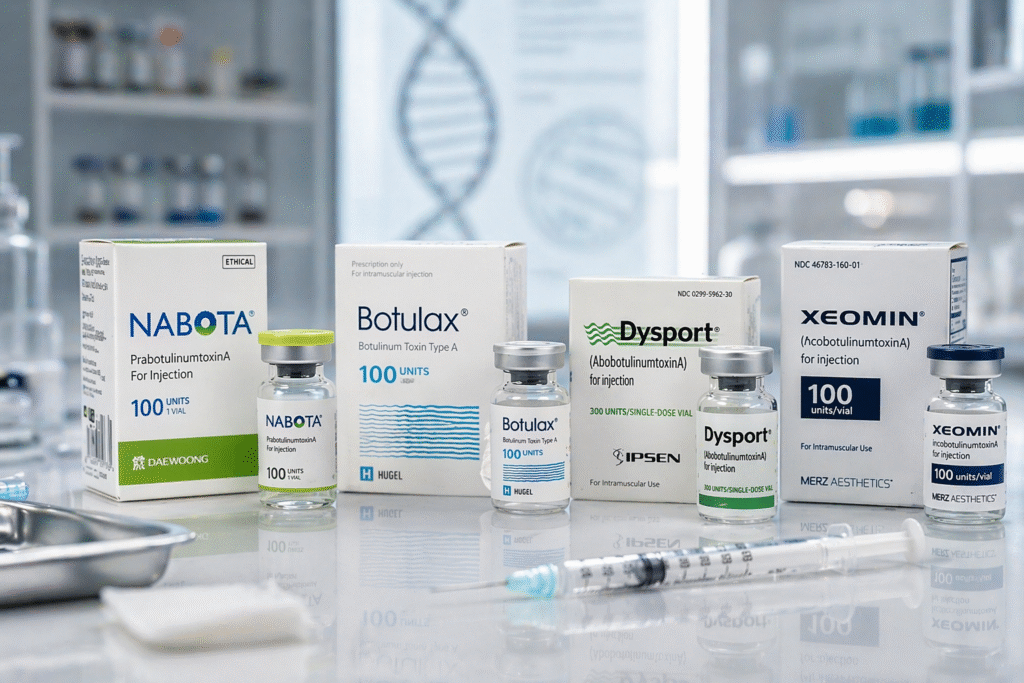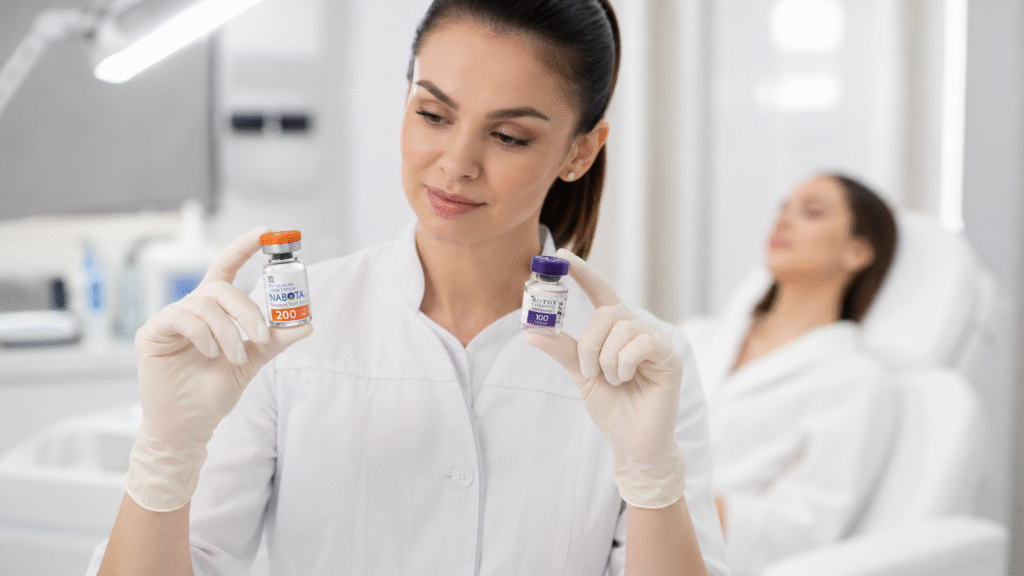
Nabota vs Botox is a common comparison, and the short answer is: related, not identical. Both are botulinum toxin type A products that temporarily reduce selected muscle activity, but they differ in manufacturer, labeling and market authorization. Nabota is made by Daewoong Pharmaceutical in South Korea. Botox Cosmetic contains onabotulinumtoxinA and is marketed by Allergan Aesthetics, an AbbVie company. Units of one are never converted into units of the other. KoreaDerma supplies Korean-market Nabota vials for professional buyers and does not sell Botox Cosmetic. This Botox comparison covers how each product works, expected effects, documented side effects, how to read Nabota reviews, and available alternatives.
Nabota vs Botox at a glance
|
Feature |
Nabota |
Botox Cosmetic |
|---|---|---|
|
Active product |
Botulinum toxin type A; Daewoong's toxin is licensed in the US as prabotulinumtoxinA-xvfs |
onabotulinumtoxinA |
|
Manufacturer |
Daewoong Pharmaceutical, South Korea |
Allergan (AbbVie), USA |
|
Market names |
Nabota (Korea/most markets); Jeuveau (US); Nuceiva (EU/Canada) |
Botox Cosmetic |
|
Regulatory status |
MFDS-authorized in Korea; the toxin also holds FDA/EMA/Health Canada approval under other brand names |
FDA-approved in the U.S. |
|
Approved uses |
Market-specific; the related US product (Jeuveau) covers glabellar lines only |
US: glabellar, canthal, forehead lines, platysma bands |
|
Vial sizes at KoreaDerma |
50, 100, 150, 200 units |
50, 100 units (not sold here) |
|
Units |
Product-specific, never converted between brands |
Same rule per labeling |
Key Terms
- Botulinum toxin type A – purified neurotoxin from Clostridium botulinum.
- Neuromodulator – injectables, that temporarily alter nerve-to-muscle signalling.
- OnabotulinumtoxinA – the official active name of Botox and Botox Cosmetic.
- PrabotulinumtoxinA-xvfs – the official U.S. name of Jeuveau, built on Daewoong's toxin.
- Dynamic wrinkle – a line that appears with muscle movement.
- Cosmetic injectable – any injectable for aesthetic purposes: toxins, fillers, boosters.
- Product-specific unit – a potency measure valid only for one manufacturer's product.
What Is Nabota?
Nabota is a Nabota botulinum toxin type A product made by Daewoong Pharmaceutical in South Korea for professional use, shipped as a powder for reconstitution – the vial can look nearly empty because contents are dried.
Daewoong launched Nabota in Korea in 2014, later registering the same programme abroad as Jeuveau (US) and Nuceiva (Europe/Canada). KoreaDerma lists four sizes: 50, 100, 150 and 200 units. A larger vial simply holds more units – not stronger or faster, and its count doesn't read across to another brand.
What is Botox Cosmetic?
Botox Cosmetic is an onabotulinumtoxinA product for aesthetic use manufactured by Allergan Aesthetics. It is available strictly by prescription and supplied in 50- and 100-unit vials. In the US, the product is approved for the correction of glabellar lines, crow's feet (wrinkles at the corners of the eyes), horizontal forehead lines, and platysmal bands. Indications approved for the therapeutic version of Botox do not apply to the aesthetic product, and the list of approved uses may vary by country.

Is Nabota the same as Jeuveau?
Jeuveau is the U.S. brand for prabotulinumtoxinA-xvfs, licensed from Daewoong by Evolus in 2013 and FDA-approved February 1, 2019 for glabellar lines. Daewoong manufactures; Evolus markets. The Western-market formulation has been noted in publications as differing from the original Daewoong formulation in drying method and excipient source. FDA approval attaches to Jeuveau's registered presentation – not to Korean Nabota cartons – so buyers must check the actual label against their own jurisdiction's rules.
How Nabota and Botox work?
Both are botulinum toxin type A neuromodulators. Injected into a target muscle, they temporarily interrupt acetylcholine release at the neuromuscular junction, reducing contraction and softening the dynamic wrinkle it produces. The effect is temporary, none of the products mechanically eliminate wrinkles or restore lost volume, so static wrinkles (visible at rest) may persist
This section addresses botox effects directly. Professional application is aimed at addressing issues related to facial expressions, softening dynamic expression lines, reducing the activity of specific muscles, and giving the face a more relaxed appearance for a limited period. No single product guarantees a specific result.
Onset differs by product, treatment area, dose and patient. The popular claim that Nabota acts in two to four days while Botox needs three to seven lacks a reliable direct source and should not be repeated as fact.
How long effects last
Duration is temporary and individual, depending on area, dose, patient metabolism and treatment history. No brand can guarantee a fixed number of months for every patient.
Natural-looking results depend on treatment, not only the brand
Assessment, anatomy, technique and realistic goals drive an outcome more than brand choice. No brand always produces a more natural result.
Nabota vs Botox side effects
Reported reactions include injection-site pain, redness, swelling, bruising, headache, temporary nearby-muscle weakness, temporary asymmetry, eyelid drooping, and dry eye depending on area. Which occur, and how often, depends on the product, area and patient.
Signs requiring prompt medical attention include difficulty breathing, swallowing or speaking, generalized or spreading muscle weakness, significant vision changes, severe allergic reaction symptoms, and rapidly developing neurological symptoms.
Emergency warning: Difficulty breathing, swallowing or speaking after a botulinum toxin injection requires immediate medical attention.
Nabota vs Botox: what does clinical evidence show?
The most relevant comparison is EVB-003, a randomized, double-blind, placebo- and active-controlled phase III study (UK, Germany, France, Sweden, Canada; Aesthetic Surgery Journal, 2020) of 540 adults with glabellar lines, comparing single 20-unit doses of prabotulinumtoxinA and onabotulinumtoxinA over 150 days. PrabotulinumtoxinA met the pre-specified non-inferiority margin.
Limits matter: one indication, one dose, one cycle, industry-sponsored, and the tested formulation differed from the original Korean one. Two earlier U.S. studies established efficacy against placebo only, not superiority over competitors.
Korean botulinum toxin alternatives available at KoreaDerma
The toxins category lists 22 items, including Botulax (Hugel, freeze-dried), Innotox (Medytox, ready-to-use liquid), Coretox (Medytox, protein-free formula) and Rentox (Pharma Research Bio). None is a "direct equivalent" or "cheaper Botox"; storage and handling come from each label – see shipping information.
Topical skincare, chemical peels, laser or light-based procedures, radiofrequency, ultrasound-based treatments and sun protection work through different mechanisms with different results and risks; no cream reproduces a toxin injection.
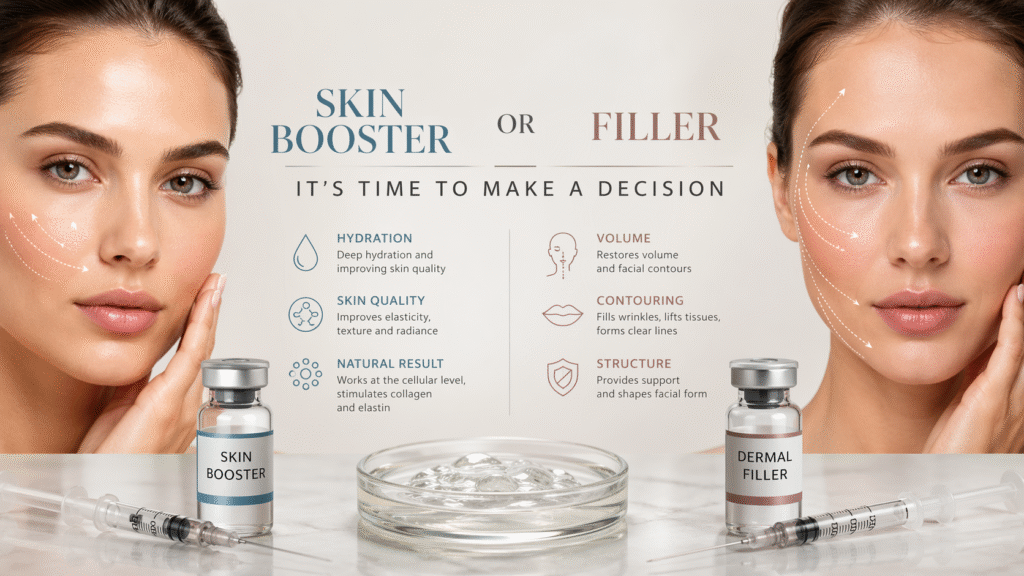
Botox vs Other Cosmetic Injectables
|
Category |
Main mechanism |
Best suited to |
|---|---|---|
|
Botulinum toxin |
Reduces nerve-to-muscle signalling |
Dynamic expression lines |
|
HA dermal fillers |
Adds volume/structure |
Volume loss, contour |
|
Skin boosters |
Hydrates/conditions skin |
Skin quality |
|
Biostimulatory injectables |
Stimulates structural response |
Gradual firmness |
|
Fat-dissolving injectables |
Targets localized fat |
Small fat pockets |
How to choose between Nabota, Botox and Other Alternatives
Start with the treatment goal. Dynamic expression lines point to neuromodulators, static lines and volume loss to fillers, hydration to skin boosters, therapeutic indications to products registered for them.
Verify authorization in the country of use. Popularity in Korea doesn't imply authorization elsewhere, and one FDA approval doesn't extend to a manufacturer's other brands. Catalog availability isn't legal clearance.
Consider the practitioner's training and product experience. The person injecting must be legally permitted to perform the procedure, and experience with the specific product matters.
Review previous response and medical history. A practitioner weighs prior reactions, duration, side effects, medical history and interactions before recommending anything.
Compare total value, not only vial price. Units aren't interchangeable, so per-unit cost can't be compared across brands, and one brand isn't always cheaper than another.
F A Q
Is Nabota the same as Botox?
No. Nabota and Botox Cosmetic are separate botulinum toxin type A products with different brand names, manufacturers, formulations and market authorizations. They belong to one treatment category, which is why they're compared, but they aren't the same medicine and their units are never interchangeable.
Is Nabota available on KoreaDerma?
Yes – KoreaDerma currently carries Nabota in four vial sizes: 50, 100, 150 and 200 units, each listed with its own price and package contents (vial, a free disposable syringe, and free saline). As you see, you can browse all four directly in the Nabota botulinum toxin category, where stock status and pricing are kept up to date on each product page.
How long do Nabota effects last?
To be honest, there is no universal figure, that applies to everyone. The effect is temporary, and its duration depends on the treated area, the dosage used, and, of course, the patient's individual characteristics.
Are Nabota units the same as Botox units?
Nope, and this trips people up a lot. Units are product-specific, so you can't just take a Nabota dose and assume it maps onto Botox Cosmetic, or vice versa. Each manufacturer runs its own potency assay to define what "one unit" even means for that product, which is exactly why no reliable conversion factor exists between brands.
What are the most common Botox side effects?
Most of what gets reported is local and doesn't stick around long – think injection-site pain, some redness, swelling, the odd bruise, a headache, maybe temporary weakness in a nearby muscle or a bit of asymmetry, drooping eyelid, dry eye if the area treated is near the eyes. How often any of this shows up really depends on the product, the area, and the person.
Is Nabota FDA-approved?
This one needs a bit of nuance. Daewoong's toxin does hold FDA approval, but under the name Jeuveau, not Nabota. The Nabota cartons sold in Korea are authorized by Korea's MFDS instead, and that's a separate registered presentation.
Is Nabota cheaper than Botox?
That can happen, but a direct comparison is difficult here. The price varies depending on the country, supplier, vial size, number of product units, and, of course, the specific clinic and the procedure itself. Furthermore, since the units of measurement for these two products are not interchangeable, it is virtually impossible to make a valid comparison of the cost per unit across different brands.