
South Korea has long held a leading position in global aesthetic medicine – and not only because of its skincare industry. Some of the most technologically advanced botulinum toxins in the world were developed right here. Korean manufacturers have invested decades of research into creating products with high purity levels, predictable clinical profiles, and formats designed with the practitioner in mind.
In this article, we take a close look at four key brands: Nabota and Botulax. Each has its own development story, distinct characteristics, and specific clinical advantages. Understanding these differences allows practitioners to make precise, well-informed choices tailored to each patient's treatment goals.
What all Korean botulinum toxins have in common
All four products:
- contain botulinum toxin type A derived from Clostridium botulinum;
- block the release of acetylcholine at the neuromuscular junction, producing temporary muscle relaxation;
- are manufactured at facilities certified by the MFDS (Ministry of Food and Drug Safety, Republic of Korea);
- are intended for professional use only – exclusively by licensed medical professionals.
The mechanism of action is identical across all four. The toxin cleaves the SNAP-25 protein on the presynaptic membrane, thereby preventing the fusion of acetylcholine-containing vesicles with the cell membrane. Of course, under the influence of the preparation, the muscle ceases to receive nerve impulses and relaxes; the overlying skin becomes smooth. The effect is temporary: as new nerve endings sprout and innervation is restored, normal muscle function gradually returns.
Significant differences among the brands lie in their degree of purification, molecular structure, composition of excipients, and pharmaceutical form, as well as in the clinical implications that these factors entail regarding diffusion, onset of action, and immunogenicity.
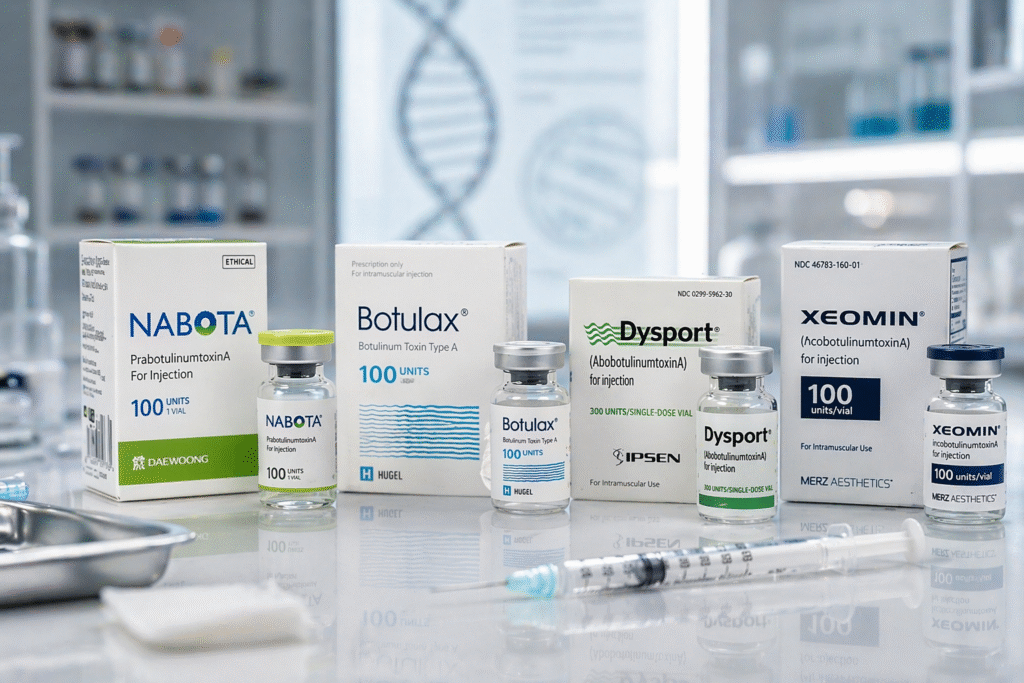
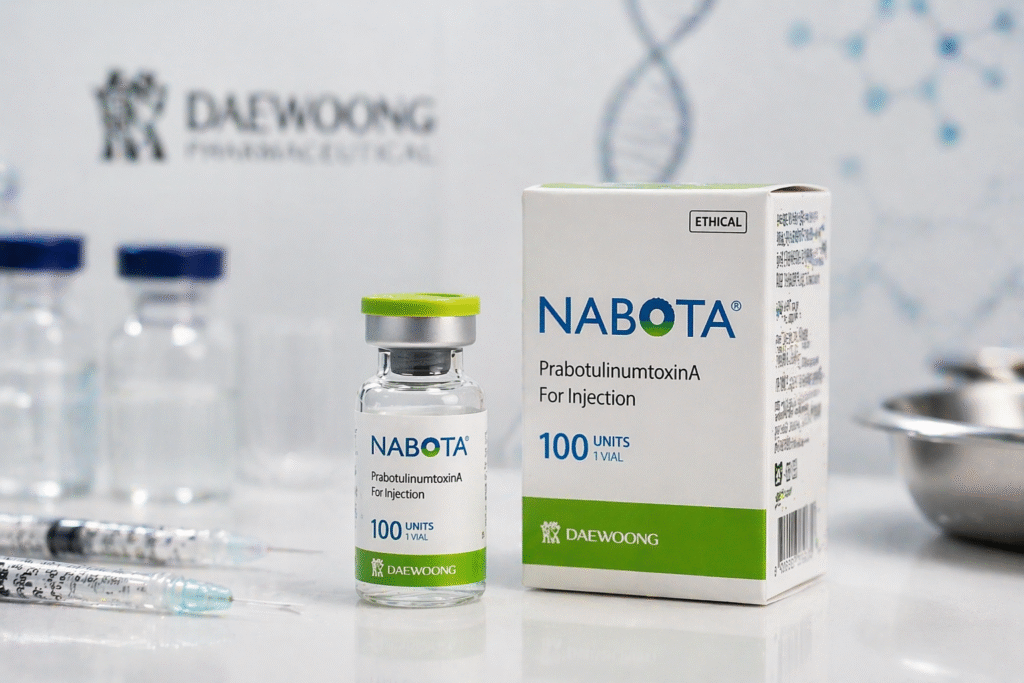
Nabota – the first Korean botulinum toxin to receive FDA approval
Manufacturer
Nabota is manufactured by Daewoong Pharmaceutical Co., Ltd., a South Korean biopharmaceutical company with over 30 years of experience in biotechnology. The neurotoxin production center is located in Seongnam, Gyeonggi Province. The product is available in 100-unit and 200-unit vials.
Key characteristics
Nabota is produced using the proprietary Hi-Pure™ technology, which achieves a concentration of the active 900 kDa botulinum toxin complex at greater than 98.7% of total protein. This makes Nabota one of the highest-purity botulinum toxins on the market.
A critical aspect of its molecular profile: Nabota is a 900 kDa biosimilar of Allergan's Botox. Both products share the same molecular weight and protein complex structure, of course, which means standard dosing protocols transfer directly – no unit conversion required. For practitioners transitioning from Allergan products, this is a significant practical advantage.
Each vial contains: botulinum toxin type A (100 units), human serum albumin (0.5 mg), sodium chloride (0.9 mg). The product is preservative-free, which reduces the risk of adverse reactions in sensitive patients.
One additional manufacturing detail worth noting: Nabota is produced via vacuum dehydration, a process that minimizes the formation of inactive toxin species – the very forms most likely to trigger the development of neutralizing antibodies with repeated treatments.
Clinical data
The product has been evaluated in large-scale clinical trials involving more than 2,000 patients across the United States and Europe. Registered study data show that more than 67.5% of participants achieved an improvement of 2 or more points on the Glabellar Line Scale (GLS).
Regulatory status
Nabota is the only Korean botulinum toxin with FDA approval (February 2019). In the United States, it is marketed under the brand name Jeuveau by Evolus. EMA approval has also been granted (marketed as Newtox in Europe), along with Health Canada approval. Nabota is currently registered in 69 countries.
On the domestic Korean market, Nabota holds approximately 32% market share among botulinum toxin brands.
Best clinical fit
Nabota is the optimal choice for clinics that prioritize predictability and protocol reproducibility. Its high purity level reduces immunogenicity risk with long-term, repeated use. The direct unit-for-unit conversion from Botox makes the transition straightforward for practitioners who previously worked exclusively with Allergan products.
Treatment areas: glabella, forehead, periorbital zone, chin, neck (platysma), axillae for hyperhidrosis, masseter for benign masseteric hypertrophy.
Botulax – the volume leader on the Korean market
Manufacturer
Botulax is manufactured by Hugel Inc., the market leader in Korean aesthetic medicine. Founded in 2001, with headquarters and production facilities in Chuncheon, Gangwon Province. Hugel is the only South Korean company with regulatory approvals in the world's three largest botulinum toxin markets: the United States, China, and Europe.
The product is available in three formats: 100, 200, and 300 units. The 300-unit vial is particularly relevant for therapeutic protocols – spasticity treatment, hyperhidrosis management, and body contouring applications.
Key characteristics
Botulax contains botulinum toxin type A derived from the CBFC26 strain. Molecular weight: 900 kDa. Purity level: greater than 99%. Stabilizer: human serum albumin – the industry standard for most botulinum toxins.
Unlike some higher-purified formulations, Botulax retains accessory hemagglutinin proteins as part of its native protein complex. This influences the diffusion profile: some studies indicate a slightly broader tissue distribution compared to stripped-down high-purity formulas – particularly relevant when treating larger muscle groups.
Vial composition: botulinum toxin type A (100, 200, or 300 units depending on format), human serum albumin 0.5 mg, sodium chloride 0.9 mg. Supplied as a lyophilized powder for reconstitution with sterile saline.
Standard reconstitution protocol: 100 units diluted in 2.5 mL of 0.9% normal saline yields a concentration of 4 units per 0.1 mL.
Botulax has an extensive evidence base and has been evaluated in clinical studies confirming efficacy comparable to established reference products for the correction of dynamic wrinkles.
Regulatory status
Botulax is registered in more than 70 countries. It holds MFDS approval (Korea), CE marking (Europe), UAE regulatory approval (January 2025), and approvals across a number of additional MENA markets. In the USA Botulax is registered under Letybo brand and has FDA approval.
On the domestic Korean market, Botulax holds the top position by sales volume.
Best clinical fit
Botulax is particularly popular in protocols requiring treatment of large surface areas: the neck, décolletage, calves (gastrocnemius hypertrophy), and masseter. The 300-unit format lowers per-unit cost when product volume is high – making it economically practical for therapeutic indications.
Treatment areas: glabella, forehead, periorbital zone, masseter, platysma, gastrocnemius, axillae, palms for hyperhidrosis.
Korean botulinum toxins are not simply more affordable alternatives to Western brands. They are independent products with their own development histories, patented manufacturing technologies, and proven clinical efficacy. Nabota and Botulax, collectively cover every major clinical scenario in aesthetic medicine, giving practitioners the flexibility to build truly individualized treatment protocols.
All products listed here are available to order through the Korea Derma catalog – shipped directly from Korea with cold chain compliance and authenticity guaranteed by the official manufacturers.
This article is intended for informational purposes only and is directed at licensed medical professionals. Botulinum toxin products must only be administered within the scope of a professional medical practice, by qualified practitioners, and in accordance with the applicable regulations of their jurisdiction.