Most Korean fillers are cross-linked hyaluronic acid (HA) gels, the same material class as Juvéderm and Restylane. The main differences are in cross-linking technology, gel texture, longevity, price and regulatory status. Korean brands such as Revolax, Neuramis and Yvoire are valued for natural-looking results, wide product ranges and accessible clinic pricing. Western brands lead on long-term clinical research and FDA approval. Non-HA fillers such as Radiesse and Sculptra work differently and cannot be dissolved. In practice, results depend most on product choice and injector skill. This guide from Korea Derma compares Korean dermal fillers with Western HA fillers and with other filler types.
What are Korean Dermal fillers?
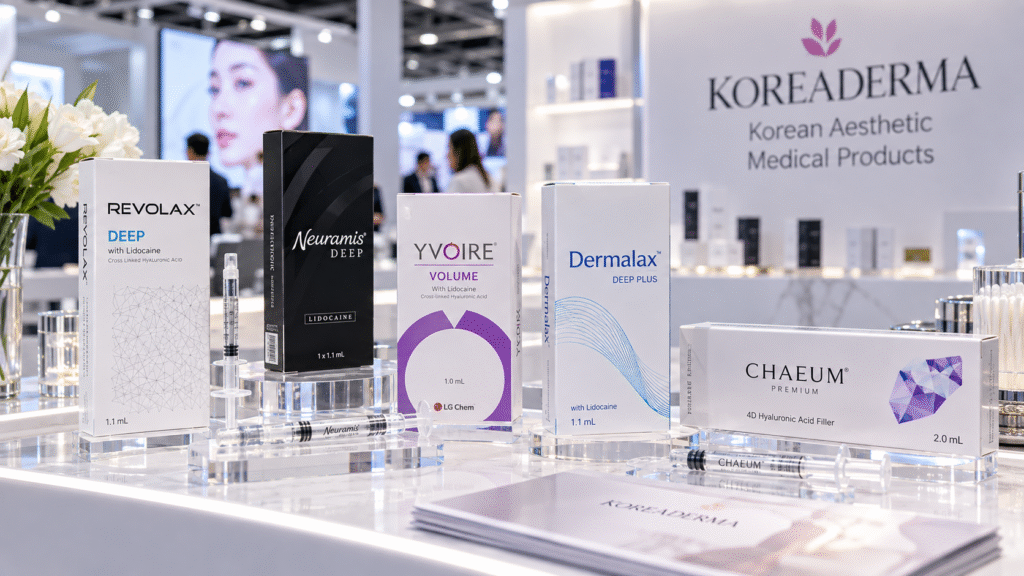
Korean dermal fillers are cross-linked HA gels made by South Korean manufacturers and regulated by the Ministry of Food and Drug Safety (MFDS). Several brands also carry CE marking. The key manufacturers are Across Co., part of the Hugel group (Revolax, Dermalax), Medytox (Neuramis) and LG Chem (Yvoire).
Purity is a central selling point. Residual BDDE, the cross-linking agent, is not detectable in Revolax and Dermalax and is below 0.4 ppm in Neuramis. Most gels contain 0.3% lidocaine and come in 1 ml or 1.1 ml syringes. Each brand offers several gels of different firmness for different treatment depths.
Korean vs Western HA fillers at a glance
Korean and Western HA fillers share the same core ingredient but differ in technology, range structure. Western brands such as Juvéderm, Restylane, Belotero and Teosyal have the largest body of clinical data and FDA approval. Korean brands compete based on data regarding product purity and a wide product range.
Parameter |
Korean HA fillers |
Western HA fillers |
|---|---|---|
Main ingredient |
Cross-linked HA, 20-24 mg/ml |
Cross-linked HA |
Cross-linking technology |
Proprietary: HICE (Yvoire), SHAPE (Neuramis), UPHEC (Rejeunesse) |
Proprietary BDDE-based technologies |
Gel structure |
Mostly monophasic |
Monophasic and biphasic ranges |
Lidocaine |
0.3% in most lines |
Available in most ranges |
Typical longevity |
6-18 months, by product |
Some products labeled for 12-24 months |
Product range |
3-4 gels per brand, fine-line to volumizer |
Broad ranges with product-specific indications |
Price for clinics |
From $43 per 1.1 ml syringe at Korea Derma |
Typically higher |
Cross-linking and purity
Both Korean and Western hyaluronic acid (HA) fillers utilize BDDE cross-linking, yet each Korean brand employs its own proprietary technology. Yvoire products feature HICE technology and high-molecular-weight HA. Revolax is a monophasic gel with a highly dense structure, that contains no detectable residual BDDE. Rejeunesse is manufactured using UPHEC technology and is also free of detectable BDDE. The production process for Chaeum Premium relies on low-temperature cross-linking and prolonged dialysis.
Most Korean gels are monophasic, meaning they are a smooth, uniform gel rather, than particles suspended in a carrier. Western ranges include both monophasic and biphasic gels.
Texture and rheology (G’)
G’ (elastic modulus) measures how firm a gel is and how well it holds its shape under pressure. Low-G’ gels spread softly and suit superficial lines and delicate areas. High-G’ gels resist deformation and are chosen for contouring.
Korean brands build their ranges along this scale:
-
Revolax Fine is the soft gel for fine lines and lip contouring.
-
Revolax Deep 1.1 ml s designed for the correction of moderate to deep wrinkles.
Revolax Sub-Q filler is the densest gel in the range, used for contouring.
The Neuramis (Light, Deep, Volume), Yvoire (Classic, Volume, Contour), and Chaeum Premium (Nos. 1–4) product lines are structured according to the same principle of density gradation – ranging from soft to denser formulations. Western brands organize their product lines in a similar way.
The effects of Korean fillers typically last for 6–18 months (depending on the specific product), whereas some Western fillers have a stated duration of 12–24 months. The actual longevity of the results depends on the treatment area, gel density, and, of course, the patient’s individual characteristics. These figures represent ranges stated by the manufacturer rather, than guaranteed timeframes.
Korean fillers usually cost clinics noticeably less than Western brands. That allows a lower procedure price for patients or a better margin for the clinic.
Current Korea Derma prices:
Revolax Deep 1.1 ml: $43
Revolax Fine 1.1 ml: $45
Yvoire Volume 1 ml: $59
-
Chaeum Premium No.3 filler (1.1 ml × 2): $55
Clinic prices for Western brands are typically higher. A lower price does not mean lower standards. For example, LG Chem produces its own HA raw material for Yvoire.
Regulatory status and clinical data
Korean fillers are approved in Korea by MFDS, and some carry CE marking, but none is FDA-approved as a finished filler for the US market.
CE marking applies to Revolax, Neuramis, Yvoire and Dermalax. In April 2026, Neuramis Deep Lidocaine and Volume Lidocaine received CE marking under the EU Medical Device Regulation (MDR). LG Chem’s hyaluronic acid raw material is registered with the FDA (Drug Master File). This is not approval of the finished filler.
Product-level clinical data also exist:
-
Revolax Sub-Q was tested in a 24-week multicenter randomized split-face study for nasolabial folds against a reference filler (ClinicalTrials.gov, NCT02179606).
Rejeunesse Shape was studied against Restylane Perlane (NCT07770789).
Western brands still lead by overall volume of research.
Korean HA fillers vs Non-HA filler types
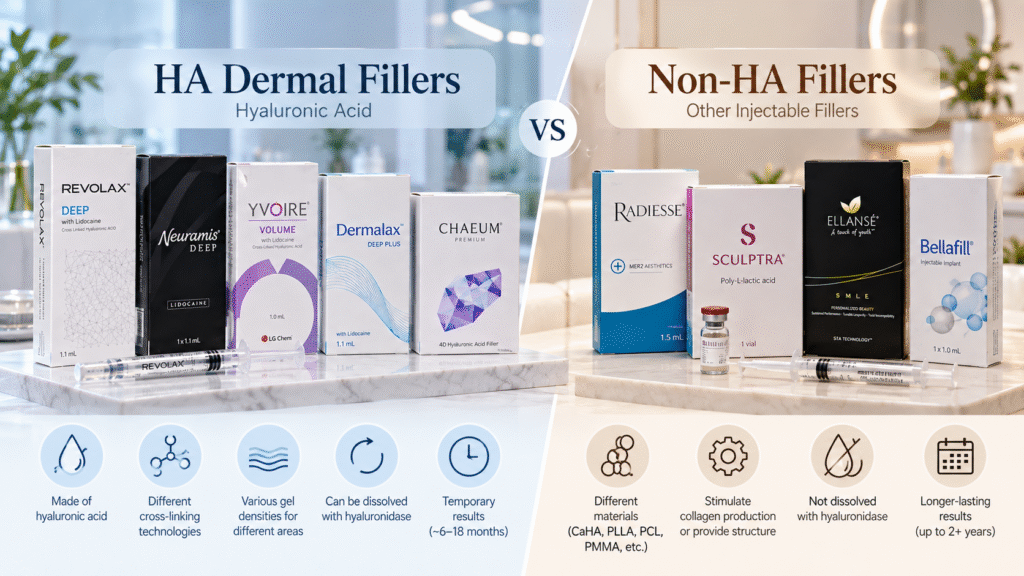
HA fillers, whether Korean or Western, are the only filler type that can be dissolved with hyaluronidase. This makes HA the most controllable option.
Other filler types work by different mechanisms:
-
Calcium hydroxylapatite (CaHA, Radiesse) and poly-L-lactic acid (PLLA, Sculptra) are biostimulators. They support tissue and prompt the body to build its own collagen, so results develop and fade differently from HA.
Polycaprolactone (PCL) is another collagen-stimulating material.
Polymethyl methacrylate (PMMA) .
Filler type |
Examples |
How it works |
Typical longevity |
Reversible? |
|---|---|---|---|---|
HA (Korean and Western) |
Revolax, Neuramis, Yvoire, Juvéderm, Restylane |
Binds water, adds volume directly |
6–18 months (Korean HA) |
Yes, with hyaluronidase |
CaHA |
Radiesse |
Microspheres support tissue and great stimulate collagen |
Longer, than most soft HA gels |
No |
PLLA |
Sculptra |
Gradual collagen stimulation over several sessions |
Long-lasting, builds gradually |
No |
PCL |
PCL-based fillers |
Carrier gel with collagen-stimulating microspheres |
Depends on formulation |
No |
PMMA |
PMMA-based fillers |
Non-resorbable microspheres |
Permanent |
No |
Many specialists choose hyaluronic acid for areas where the reversibility of the effect is important, such as the lips and the under-eye area.
Popular Korean fillers and their Western counterparts
Korean product |
Main use |
Comparable Western category |
|---|---|---|
Fine lines, lip contouring |
Soft superficial HA |
|
Moderate-to-deep wrinkles |
Mid-depth HA for folds and lips |
|
Contouring, deep volume |
High-G’ volumizer |
|
Neuramis Light |
Fine lines |
Soft superficial HA |
Neuramis Deep |
Folds, lips |
Mid-depth HA |
Neuramis Volume |
Volume restoration |
Volumizer |
Yvoire Classic |
Fine-to-moderate wrinkles |
Soft-to-medium HA |
Deep wrinkles, facial contouring |
Volumizer |
|
Yvoire Contour |
Structural contouring |
High-G’ contour HA |
Fine lines, hydration |
Soft superficial HA |
|
Dermalax Deep Plus |
Folds, lips |
Mid-depth HA |
Chaeum Premium No.1–4 |
Fine lines (No.1) to contouring (No.4) |
Full soft-to-volumizer range |
Why clinics choose Korean Fillers – and where to buy them
Clinics choose Korean fillers for three reasons: wide ranges, lower purchase prices and documented purity.
The primary risk is counterfeit products. To avoid this, purchase goods only from suppliers, who source them directly from manufacturers or authorized distributors.
Korea Derma supplies clinics with:
16 brands of Korean fillers, with separate gels for different zones
-
100% original products, sourced from manufacturers and official distributors, with documents available on request
Controlled storage and transport, orders ship from Korea within 1-2 business days
Sales to licensed professionals only
FAQ
Are Korean fillers as good as Juvéderm or Restylane?
Korean HA fillers are comparable in material and technology, and they are designed for similar indications. Western brands have more clinical data and FDA approval. Korean brands offer low residual BDDE, broad ranges and lower clinic prices.
How long do Korean fillers last compared to Western fillers?
Korean fillers typically last 6-18 months depending on the product, while some Western fillers are labeled for 12-24 months. For example, Revolax usually lasts 8-12 months, and its manufacturer states up to 18 months.
Why are Korean fillers cheaper?
Korean fillers carry lower clinic prices, not lower standards. At Korea Derma, Revolax Deep 1.1 ml costs $43 and Yvoire Volume 1 ml costs $59, while Western brands are typically priced higher.
Are Korean fillers FDA-approved?
No, Korean fillers are not FDA-approved as finished fillers for the US market. Revolax, Neuramis, Yvoire and Dermalax carry CE marking. LG Chem’s HA raw material for Yvoire is registered with the FDA through a Drug Master File.
What is the difference between monophasic and biphasic fillers?
Monophasic fillers are a uniform, smooth gel, while biphasic fillers contain cross-linked particles in a carrier. Most Korean fillers, including Revolax, Dermalax and Rejeunesse, are monophasic. Western ranges include both types.
Which Korean filler brand is best for lips?
No single brand is best for every patient. Soft to medium monophasic gels are most often used for lips. Revolax Fine and Rejeunesse Fine are common choices, and the final decision rests with the injector.