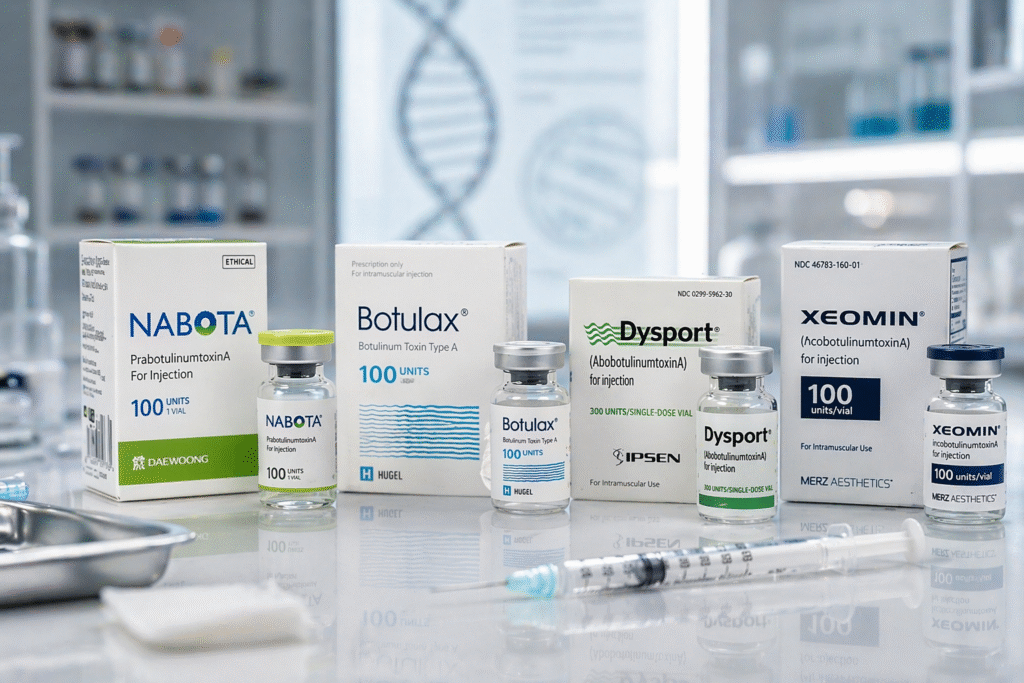
Two clinics order the same Botulax 100U from the same shelf in our warehouse. Same batch, same courier, same week. One reports beautiful glabellar results at four days. The other says the product "feels weak" and asks whether we've changed supplier.
Nine times out of ten the difference isn't the vial. It's what happened in the two minutes after the cap came off.
Reconstitution is the least glamorous part of toxin work and the part with the most room for silent error, because a mistake here doesn't announce itself. Nothing spills, no alarm goes off. The patient just comes back at week two saying it didn't do much, and by then nobody remembers how much saline went into that vial.
We've never written about this, so here it is. Not a protocol to replace your product insert. A working checklist from the supply side, plus the specific mistakes we hear about most.
Before anything: know which format you're holding
Korean toxins come in three physical formats and they don't behave the same on the bench.
Freeze-dried (lyophilised) – Botulax, Liztox, Coretox, Wondertox, Toxta and most others. You'll see a visible white cake or powder at the bottom of the vial.
Vacuum-dried – Nabota is the well-known one. The vial looks empty. Genuinely, disturbingly empty, and every few months someone contacts us convinced they were shipped blanks. The residue is a thin transparent film on the glass. That's normal, that's the product, don't send it back.
Liquid, ready to use – Innotox. No reconstitution at all. Draw and inject. This removes a whole category of error, which is a fair argument for stocking it alongside a powder product if your team is large or turnover is high.
For a broader look at how the brands differ in onset and diffusion, we've covered that in Nabota vs Botox and in the Nabota and Botulax comparison.
The saline question
Sterile 0.9% sodium chloride, preservative-free. That's what the inserts specify and that's what should be in your drawer.
You'll hear the argument for bacteriostatic saline, the one containing benzyl alcohol, it stings less on injection and there's a body of practice behind it, particularly in the US. It is also outside the labelled instructions for these Korean products, and it isn't reliably available in a lot of the markets we ship to. Our position as a supplier is simple and deliberately straightforward, follow the instructions on the insert included in the box. If you choose to do otherwise, that is your own clinical decision – not a "shortcut" we would recommend in writing.
What definitely doesn't belong anywhere near a toxin vial, water for injection on its own, lidocaine, anything you've already drawn up for another purpose, and any saline ampoule that's been sitting open on the tray since the last patient.

The vacuum tells you something
Swab the rubber stopper with alcohol and let it dry properly. Don't lever off the whole aluminium ring, just the plastic flip-off centre.
Now the part worth paying attention to. An intact vial holds negative pressure. When you pierce the stopper, the saline should be pulled in on its own. If you have to push it in, or if the vial takes the fluid with no resistance at all, the seal has been compromised somewhere between the factory and your table. That's not a dilution problem, that's a "set this vial aside and photograph it" problem.
Let the saline run down the inner wall of the glass rather than jetting it straight onto the powder.
Then swirl. Gently, a few seconds, until it's clear. Do not shake. Botulinum toxin is a protein and foaming at an air-liquid interface is one of the ways you degrade it. If your vial looks like a shaken soda bottle, you've already lost something you can't measure.
Reconstituted product should be clear and colourless with nothing floating in it. Particles or cloudiness, don't inject it.
The dilution table, and what it actually means
For a 100U vial:
|
Saline added |
Units per 0.1 ml |
Typical use |
|---|---|---|
|
1.0 ml |
10 U |
Very concentrated, large muscles, minimal spread |
|
2.0 ml |
5 U |
Common all-purpose choice |
|
2.5 ml |
4 U |
The most widely used facial dilution |
|
4.0 ml |
2.5 U |
Broader fields, superficial work |
|
5.0 ml |
2 U |
Wide areas, hyperhidrosis-style grids |
For a 200U vial every one of those numbers doubles. Which sounds obvious written down, and is exactly where the most common real-world error lives: someone reconstitutes a 200U vial with 2.5 ml, keeps "4 units per 0.1 ml" in their head from years of 100U habit, and delivers double the intended dose to every point. The patient's forehead goes completely flat and stays that way for four months. We hear this story about twice a year, always from busy clinics, never from careless ones.
Concentration is a clinical variable, not a convenience
The instinct is to treat dilution as the thing you do so the volume is comfortable to inject. It's more than that.
More saline means more volume per injection point, and more volume spreads further through tissue. Less saline means a tighter, more contained field. The published evidence on how much spread differs between dilutions is honestly messier than injectors usually assume, but the direction is consistent enough to work with.
Practical translation:
- Glabella, crow's feet, lip flip, anything near the levator or the depressors – concentrated. You want the effect where you put it, and nowhere near the eyelid.
- Masseter, calves, large body muscles – more dilute is fine and arguably better, since even distribution through a big muscle belly is the goal.
- Sweat-gland work over an area – dilute, because coverage matters more than precision.
- Very superficial, low-dose skin work – dilute, small volumes, many points. If that's the direction you work in, our piece on microdosing goes further into placement.
One thing that follows from all this, a house dilution standard is a good idea. If everyone in your clinic reconstitutes at the same concentration for the same indications, your results become comparable across practitioners and your notes start meaning something. Chaos here is why some clinics can't tell whether a new brand is working for them or not.
Small things that add up
- Change the needle after drawing. Pushing a needle through a rubber stopper blunts it. Injecting a patient with the same needle you used to draw is a comfort problem and a technique problem. Insulin-style syringes with fixed needles are popular for exactly this reason, since the dead space is minimal too.
- Dead space costs you units. A conventional Luer syringe plus hub can retain a meaningful fraction of a 0.1 ml aliquot. Across a full vial that's real product going into a sharps bin.
- Units are product-specific. Korean products are used at the same dosages doctors are accustomed to, however, no regulatory body in the world considers the units of activity of different products to be interchangeable. When switching to a different brand, one should review the instructions rather, than simply carrying over the previous figures.
The part we'd rather not have to write
Everything above assumes a licensed practitioner in a clinical setting. There is currently a wave of people online reconstituting toxin at home from vials bought who-knows-where, and articles like this one get read by them too.
To be direct about it, dilution maths is the easiest part of injecting toxin. The hard parts are anatomy, dosing judgement, and knowing what to do, when something goes wrong three days later. We supply professionals, and we'd like the products we ship to stay in professional hands.
If you're stocking up
Vial size choice ties into all of this more, than people expect. 200U vials are cheaper per unit and make sense when you're confident of using them, and they punish inconsistent dilution habits harder, than 100U vials do. If you're a single-practitioner clinic doing a handful of areas a week, the 100U format usually wastes less than the price difference saves.
Our toxin range is here, and if you want a straight answer about vial sizes for your patient volume, ask us on WhatsApp or at sales@koreaderma.shop. Mon–Fri, 9–6 KST. We'd genuinely rather talk you out of the wrong order than process it.