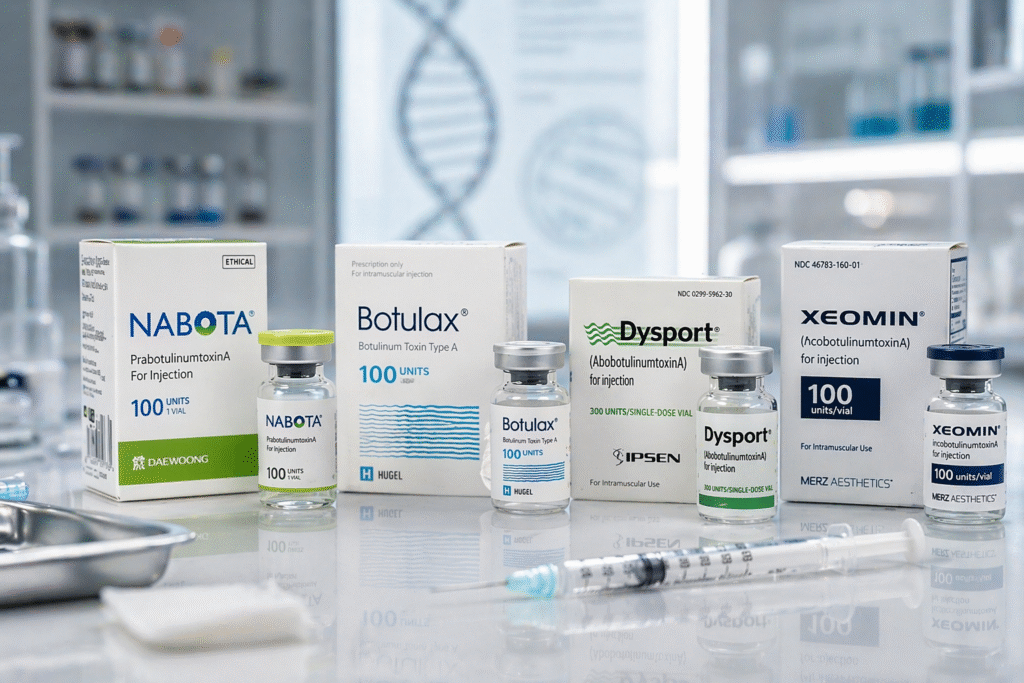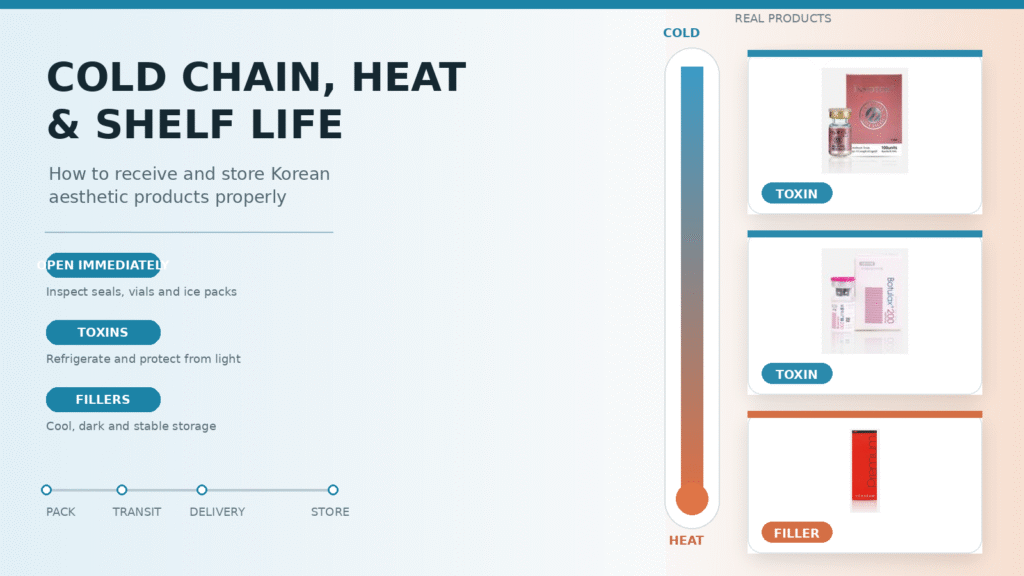
This is the article nobody in our industry wants to write, because writing it means admitting shipping is not magic. We pack toxins in insulated boxes with ice packs, hand the parcel to a courier, and from that moment the weather, the customs queue, and a driver's route are running the show. Most clients never think about any of this. Fine, when everything goes smoothly. But the clinics that understand what happens inside that box are the ones who never have a bad month.
What heat really does to a toxin
Botulinum toxin is a protein, and proteins are fragile in a specific way. Heat does not "spoil" them like milk; it unfolds them. The molecule loses its three-dimensional shape, and a misfolded protein cannot bind where it is supposed to bind. The result is not a dangerous product. This type of case falls into the "quieter" category, the product proves less effective, than stated on the bottle, its effects wear off sooner than the patient expected, and the specialist wonders whether the manufacturer has altered the formulation.
An important nuance: the process here operates on a gradient principle rather than an "on/off" switch. Modern lyophilized toxins are far more stable than is commonly believed within the industry; if the powder spends a warm day in transit, it certainly won't spoil. Its efficacy might decrease only slightly compared to a product transported during winter. That is precisely why we do not hide this information but disclose it before an order is placed: a client who understands the nuances makes a more informed decision than one who was promised ideal conditions.
Fillers behave differently. Cross-linked HA gel is not a protein, and it tolerates ambient temperature far bette, heat is rarely the enemy there. Freezing, on the other hand, can compromise gel structure. Different products, different vulnerabilities, and treating your entire order as one homogeneous thing is where mistakes start.
The first fifteen minutes after delivery
Here is the routine we wish every clinic followed, and the ones who do almost never contact us with problems.
Open the box immediately, without waiting until the end of the day. Take a photograph of the contents (including the ice packs) before unpacking, ensuring the date and time of the photo are recorded. Inspect the vials, the caps must be intact, the seals undamaged, and the powder inside must retain its normal form without any reduction in volume or change in color. Afterward, your first priority should be to ensure proper storage conditions for all contents, including the accompanying documents.
Storage that actually protects your investment
Lyophilized toxins should be stored in the refrigerator – specifically in the main compartment rather, than the door, where the temperature fluctuates every time it is opened. They should not be placed in the freezer unless explicitly instructed by the manufacturer, errors in this regard can prove costly. Keep the vials in their original packaging, as exposure to light affects the product more significantly than is commonly realized.
Fillers and boosters want a cool, dark, stable cupboard, away from windows and away from the autoclave, that turns one corner of the room into its own microclimate. Anesthetic creams need room temperature and a tight cap. They dry out and separate when handled carelessly. Disposables need dry storage and intact packaging, full stop.
Buy an inexpensive digital thermometer with a min/max recording function and leave it in the refrigerator. It costs less than a single vial of medication, yet it has repeatedly saved our clients from compressor failure – a malfunction they hadn't even suspected.
Clinics are frequently asked whether the date on the packaging represents a "critical cutoff" or merely a recommendation. The expiration date specified by the manufacturer indicates the period during which the drug’s claimed efficacy is guaranteed. A vial stored under ideal conditions for twenty-three months and one left sitting in the sun by a window for six months are, in essence, two very different things, regardless of the date printed on the packaging.
So make dating part of how you evaluate any supplier, including us. Ask what dating you can expect on a given product before you commit to a large quantity, and ask before you order, not after the box lands. A supplier who answers, that question directly is telling you something useful about how they run their stock.
The practical rule for your own shelf: never order more, than you will realistically use inside twelve months, no matter how good the volume pricing looks. Expired inventory is not a saving. It is money you already spent, sitting in a fridge, waiting to be thrown away.
Ordering with the calendar in mind
A commercial thought, since we are a shop and pretending otherwise would be silly. Seasonality is real. Korean summers are brutal, and July through September is when transit temperatures peak along the whole route. Clinics that plan for it shift their rhythm: heavier toxin orders in cooler months, lighter and more frequent ones through the hottest stretch, fillers and disposables consolidated whenever it suits them since they carry no such risk.
Watch our holiday notices too. Korean national holidays stop dispatch for days at a time, and a parcel sitting in a courier depot over a long weekend has done nothing useful for anyone. Ordering early in the week is not superstition; it is just fewer hours in transit.
Why we tell you all this
We prefer to discuss all details before a purchase is made, rather than after; that is our approach to business. We use thermal packaging with cooling agents for every order containing toxin-based products. We always provide our customers with a clear, easy-to-understand warning regarding summer shipping conditions before they place an order. So message us before a large order and ask about timing. Sometimes the useful answer is "wait two weeks," and we would rather give it, than watch a good client have a bad experience in August. That is not clever salesmanship. It is just the cheapest way we know to still have that client next year.